

You understand what semantic SEO means. You have seen how it differs from traditional keyword optimization. Now you need to build it.
Implementation separates theory from results. I have watched businesses spend months discussing semantic concepts while their competitors capture the rankings, the traffic, and the revenue. The gap is not knowledge but execution.
Semantic SEO implementation is engineering work. It requires systematic planning, precise construction, and validation against measurable outcomes. This is not about adding a few related keywords to your existing pages. It is about restructuring how search engines understand your entire digital presence.
I am going to show you exactly how to implement semantic SEO in 90 days. This framework has generated 317% increases in qualified leads for B2B clients. It has helped e-commerce sites capture rich snippets they never targeted directly. It works because it aligns with how search engines actually process information now, not how they processed it a decade ago.
Let me walk you through the five steps.
What Semantic SEO Implementation Actually Means
Implementation is not optimization. Optimization suggests tweaking existing elements. Implementation means building new infrastructure.
When you implement semantic SEO, you are constructing a knowledge graph around your business. You are defining entities, establishing their attributes, and mapping their relationships. You are creating content that exists in the same vector space as user queries, whether those queries use your exact terminology or not.
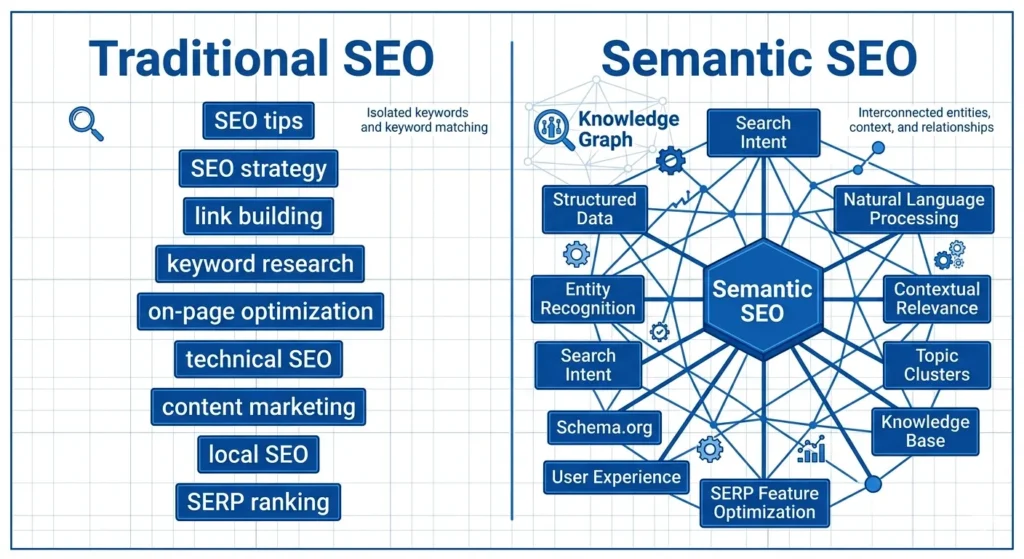
This takes time. Expect ninety days to establish the foundation. Expect six months to see significant ranking shifts. Expect twelve months to dominate topical categories. Anyone promising faster results is selling tactics, not strategy.
The businesses that succeed approach this as engineering. They audit before building. They measure during construction. They validate after deployment. They treat content as interconnected systems rather than isolated pages.
If you are looking for quick wins, semantic SEO will disappoint you. If you are building for sustainable authority, it is the only approach that matters.
Step 1 – Map Search Intent and Entity Relationships
Every search query carries intent. Before you write a single word, you must understand what your audience wants to achieve.
Understanding the Four Search Intent Types
Search intent falls into four categories. Informational intent indicates someone seeking knowledge. They want to understand concepts, learn processes, or explore topics. Queries often start with “what,” “how,” “why,” or “who.” When someone searches “what is structured data,” they are not ready to buy. They want to understand the entity “structured data” — its definition, its purpose, its applications.
Navigational intent means the user knows their destination. They search for specific brands, websites, or resources. Someone typing “Kamran Asghar semantic SEO” has already decided where they want to go. Semantic optimization here means ensuring your entity — your brand, your key personnel, your proprietary methodologies — is clearly defined in Google’s Knowledge Graph.
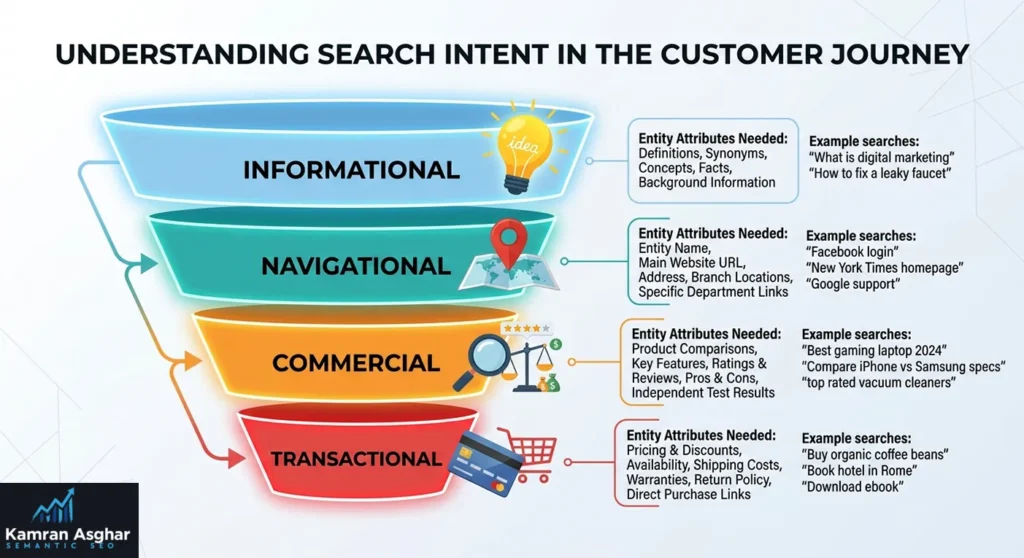
Commercial investigation involves comparing options. Users evaluate entities before committing. They search for “best semantic SEO tools” or “SE Ranking versus MarketMuse reviews.” These queries require content that presents multiple entities with clear attribute comparisons. You are not yet selling. You are facilitating decision-making by mapping entity relationships.
Transactional intent signals readiness to act. Users want to purchase, subscribe, or convert. Here entity attributes become critical like pricing, features, guarantees, social proof. Every attribute must be explicitly stated and schema-marked so search engines can extract and display them.
Conducting Entity Optimization Research
Understanding intent is only half the work. You must also map the entities in your space.
Start with your core offering. If you provide semantic SEO services, your primary entities include “semantic SEO,” “search engine optimization,” “entity optimization,” and “topical authority.” But these do not exist in isolation. Semantic SEO relates to “structured data,” “natural language processing,” “content strategy,” and “search intent.” Each of these connects to dozens more.
Research how knowledge bases structure these entities. Wikipedia and Wikidata reveal how concepts are categorized, which attributes are considered definitional, and which relationships are considered essential. Examine Knowledge Panels for competitors in your space. Note which entity attributes Google displays prominently. These are the attributes you must establish for your own brand.
Document entity-attribute pairs. For each core entity, list five to ten defining characteristics. For “semantic SEO,” these might include “focuses on meaning rather than keywords,” “uses structured data markup,” “optimizes for entity recognition,” and “builds topical authority through content clusters.” These pairs guide your content development, ensuring you cover definitional territory rather than peripheral details.
This mapping process typically takes one to two weeks. Do not rush it. Every subsequent step depends on the clarity you establish here.
Step 2 – Build Topic Clusters Using the Pillar-Cluster Model
Search engines do not evaluate pages in isolation. They evaluate how pages relate to each other, whether those relationships signal comprehensive expertise or scattered attention.
Architecting Pillar and Cluster Content
The pillar-cluster model organizes your content into interconnected webs of meaning. A pillar page covers a broad topic comprehensively, typically three thousand to five thousand words. It serves as the definitive resource, the answer to the broadest queries in your space. Cluster pages explore specific aspects, questions, or applications in greater depth — one thousand to two thousand words each.
The architecture creates semantic density. Your pillar page links to every cluster page. Each cluster page links back to the pillar. Related cluster pages link to each other. When search engines crawl this structure, they encounter the same entities repeatedly, each time with additional context and attributes. This reinforcement builds topical authority.
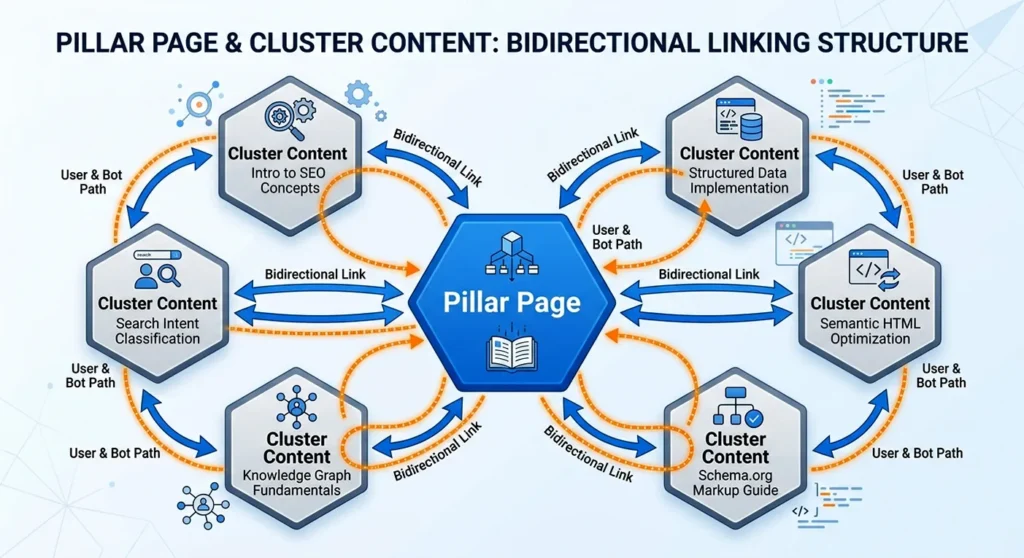
Consider how entities at the core of each pillar relate to entities in other pillars. A pillar page about “semantic SEO” naturally connects to “structured data implementation,” “content strategy development,” and “search intent analysis.” These connections should manifest in your internal linking strategy. The anchor text you choose matters immensely. “Our structured data implementation guide” communicates more entity information than “click here” or “read more.”
URL structure reinforces these relationships. Use logical hierarchies that reflect topical connections. A cluster page about schema markup might live at /blog/semantic-seo/schema-markup-implementation/. The URL itself signals the relationship between “semantic SEO” and “schema markup.”
Alternative Clustering Architectures
Breadcrumb navigation provides additional semantic cues. It shows users and crawlers exactly where each page sits in your topical hierarchy. This is not merely user experience design. It is knowledge graph construction.
Some practitioners prefer content hubs — centralized collections where all material on a specific subject lives in one location. Others use topic maps that organize content based on conceptual associations without strict primary-secondary distinctions. These approaches work, but the pillar-cluster model offers the clearest semantic signaling for search engines still learning to map relationships.
Plan your clusters before writing. Identify ten to fifteen cluster topics for each pillar. Map how they interconnect. This architecture becomes your content calendar for the next six months.
Step 3 – Conduct Semantic Keyword and Topic Research
Traditional keyword research asks “what terms have search volume?” Semantic keyword research asks “what language surrounds the entities I need to establish?”
Mapping the Language Landscape
The difference is profound. Volume-based research produces lists of terms to target. Semantic research produces maps of meaning to occupy.
Start with seed topics aligned with your core entities. Use Google’s autocomplete to discover how people actually phrase queries. The suggestions reveal the conceptual associations Google has learned. If you type “semantic SEO” and see suggestions for “semantic SEO vs traditional SEO,” “semantic SEO tools,” and “semantic SEO case studies,” you know these are the adjacent entities searchers connect to your core topic.
Examine “People Also Ask” boxes carefully. These questions reveal the subtopics and concerns Google associates with your core entity. Each question is a potential cluster page. Each question’s phrasing reveals the natural language patterns you should mirror.
Check related searches at the bottom of search results pages. These show query variations that indicate different intent angles or entity relationships. Some may surprise you, revealing connections you had not considered.
Categorizing Semantic Keywords
Distinguish between synonyms and related terms. “Yoga asana” and “yoga pose” are synonyms — interchangeable terms for the same entity. “Yoga class” is related but distinct — a different entity that connects to the first. Both matter, but for different reasons. Synonyms reinforce entity identity, helping search engines recognize when different phrasings refer to the same concept. Related terms expand topical coverage, establishing your presence in the broader semantic field.
Consider semantic keyword categories as you research. Synonyms and alternative phrasings capture the same intent with different vocabulary. Derived terms and applications show how core entities manifest in practice. Generalizations and broader categories position your specific expertise within larger contexts. Enumerations and specific types demonstrate depth. Related concepts and co-occurring phrases reveal the entity web you need to build.
Group your research by intent and thematic similarity, not just search volume. High-volume terms often indicate broad categories suitable for pillar pages. Low-volume long-tail queries suggest specific cluster content that demonstrates depth. Organize these groupings into clusters that align with your pillar architecture from Step 2.
Recent research reveals another critical factor. Pages with high semantic alignment between meta descriptions and content receive up to four point seven AI citations versus four point one for low-alignment pages. Your keyword research must inform meta descriptions that accurately reflect topical content, not just entice clicks. AI systems use these descriptions to assess relevance before citing your content.
This research phase typically overlaps with content planning. Expect to spend two to three weeks building comprehensive topic maps before writing begins.
Step 4 – Create Context-Rich, Structured Content
With your architecture planned and your research complete, you begin building. Content development is where semantic theory becomes textual reality.
Structuring for Machine Readability
Structure every piece using semantic HTML. Header tags establish information hierarchy, with H1 defining the macro context and H2s through H6s refining subtopics. Article tags identify content type. Section tags group related content. These elements are not merely stylistic. They are machine-readable signals that help search engines parse your document structure.
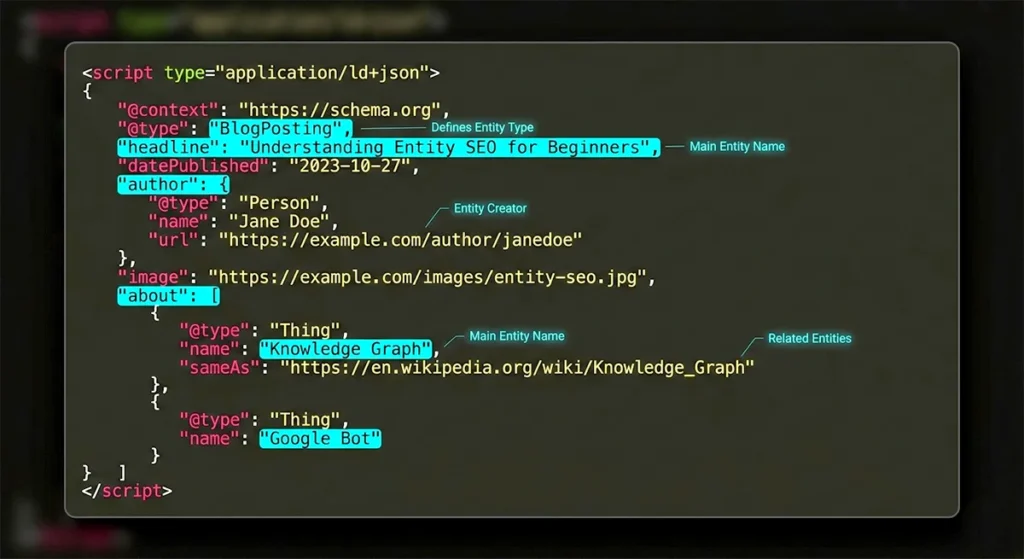
Schema markup transforms this structure into explicit entity definitions. Start with essential types: Article schema for blog posts, FAQPage for question sections, Organization for your business entity, Product or Service for offerings. Expand to specific types as relevant — HowTo for instructions, Review for testimonials, Course for educational content, Event for webinars or conferences.
Use JSON-LD format for implementation. It embeds in your page header without disrupting the user experience, making it the cleanest method for adding structured data. Google’s Rich Results Test validates your markup before deployment, catching errors that would otherwise waste your implementation effort.
Optimizing for AI Citations and Voice Search
Frame sections as questions when the content permits. Research indicates pages using question-based H1s and H2s average four point six AI citations compared to four point five for non-question headings. The difference seems small, but at scale it compounds. Questions help AI systems identify intent boundaries and extract answers efficiently. They also align with voice search patterns, where users phrase queries conversationally.
Integrate FAQ blocks directly within main content rather than isolating them at the end. Pages featuring visible FAQ sections average four point nine AI Mode citations versus four point four for pages without them. The visibility matters — FAQ schema markup alone, hidden from users, does not impact citation rates. The content must be displayed.
Prioritize content richness over arbitrary length. A five-hundred-word piece that thoroughly answers a specific query outperforms a five-thousand-word piece that buries the answer in fluff. However, pillar topics demand comprehensive coverage. Assess what the topic genuinely requires, then deliver exactly that depth without padding or cutting corners.
Include entity-dense passages throughout. Mention relevant entities naturally. Describe their attributes using the pairs you identified in Step 1. Explain relationships between entities using clear, factual sentence structures. “Schema markup helps search engines understand entity relationships” is stronger than “Schema markup is known to help with entity understanding.” The first states a fact. The second hedges unnecessarily.
Your content should create vector space proximity. When search engines convert your text to mathematical representations, related concepts should cluster together. This happens when you cover topics thoroughly rather than skimming surfaces.
Step 5 – Implement Technical Infrastructure and Schema Markup
Technical implementation makes semantic relationships explicit and machine-readable. Without this step, your content relies on search engines to infer connections you could have stated directly.
Advanced Schema Implementation Strategies
Schema markup is your primary tool. We touched on basic implementation in Step 4, but comprehensive semantic SEO requires advanced structured data strategies.
Consider structured data layering using the at-graph property. This JSON-LD feature allows multiple schema entities in a single code snippet, explicitly defining their relationships. A product page might include Product schema for the item, HowTo schema for usage instructions, FAQPage schema for common questions, and Review schema for customer ratings — all interconnected within one at-graph declaration. This builds explicit entity relationships that search engines parse without inference.
Building Semantic Internal Link Architecture
Internal linking architecture reinforces these relationships across your site. Every link should use descriptive anchor text that includes entities and context. The five to fifteen words surrounding each anchor matter as much as the anchor itself. This annotation context defines what the linked page covers for search engines analyzing reference contexts.
Site architecture provides the skeleton. Menu structures should reflect topical hierarchies. Breadcrumb navigation shows exactly where each page sits in your content ecosystem. URL structures use logical directories that signal relationships. These elements help both users and crawlers navigate your semantic web.
Page speed and mobile-friendliness remain important, but primarily as enablers. Slow pages prevent crawlers from accessing your content. Poor mobile experiences reduce engagement signals. Address these fundamentals, but recognize they support semantic SEO rather than constituting it.
Validation closes the implementation loop. Use Google’s Rich Results Test to verify schema markup. Use Search Console to monitor indexing and rich result appearances. Use analytics to track whether semantic optimization correlates with ranking improvements for target topics.
Measuring Semantic SEO Success: KPIs Beyond Rankings
Traditional SEO metrics capture only part of semantic success. You need additional indicators to validate your implementation.
Tracking Topical and Entity Recognition
Topical coverage breadth reveals semantic reach. Monitor how many related queries drive impressions in Search Console. Semantic optimization should increase visibility for terms you never explicitly targeted. When your pillar page on semantic SEO starts generating impressions for “entity optimization,” “structured data benefits,” and “topical authority building,” your semantic signals are working.
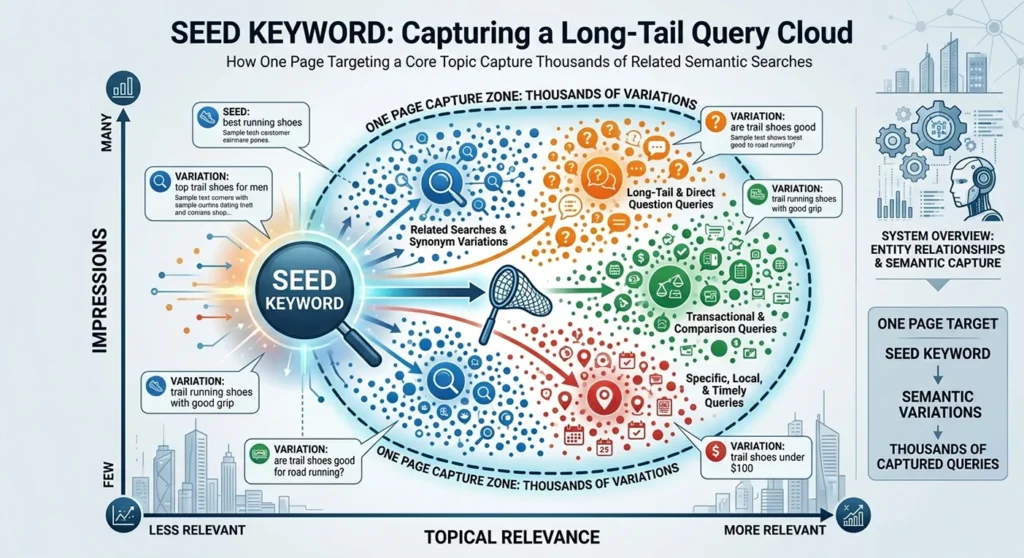
Entity recognition indicates Knowledge Graph integration. Search for your brand name. Does Google display a Knowledge Panel with accurate information? Are your key personnel recognized as entities? Do searches for your proprietary methodologies return your content? These signals confirm that search engines have parsed and stored your entity definitions.
Monitoring AI Citations and Engagement
AI citation rates are becoming critical as LLMs drive search behavior. Monitor how often AI systems reference your content. Specialized tools now track AI Mode citations, revealing which pages AI systems use as sources. Early data shows that pages with strong semantic optimization receive significantly more AI citations than keyword-optimized competitors.
Rich result appearances validate structured data implementation. Featured snippets indicate that search engines trust your content as the definitive answer. People Also Ask entries show your content addresses related questions comprehensively. Passage rankings demonstrate that specific sections of your content satisfy precise queries.
User engagement metrics reflect intent satisfaction. Time on page, scroll depth, and interaction rates indicate whether your content delivers what searchers seek. High engagement confirms your semantic alignment is accurate. Low engagement suggests intent mismatch despite entity coverage.
Common Implementation Mistakes That Derail Results
Even experienced practitioners make errors that undermine semantic SEO efforts.
Structural and Technical Errors
Treating topic clusters as rigid content silos is perhaps the most common mistake. Clusters interconnect. Content spans multiple pillars. A page about schema markup might serve the semantic SEO pillar and the technical SEO pillar simultaneously. Rigidity signals artificial construction rather than genuine expertise. Build connections where they naturally exist.
Over-optimizing for entities creates new forms of spam. Mentioning “semantic SEO” twenty times per paragraph triggers quality filters. Natural language with contextual variation performs better. Use synonyms. Use related concepts. Trust that search engines understand vector relationships without constant repetition.
Neglecting search intent alignment destroys performance regardless of semantic depth. You can have perfect entity coverage and comprehensive topic clusters, but if you answer informational queries with transactional content, you will not rank. Intent analysis must precede every content decision.
Implementing schema markup without validation wastes effort. Broken JSON-LD, incorrect property types, or mismatched entity declarations confuse rather than clarify. Always test structured data before deployment. Monitor Search Console for structured data error reports.
Ignoring AI citation signals leaves you optimized for yesterday’s search. As LLMs drive more discovery, optimization for AI visibility becomes non-negotiable. Monitor which content gets cited. Analyze why. Adjust your semantic signals accordingly.
Implementation Timeline: Your First 90 Days
Realistic expectations prevent abandonment before results materialize.
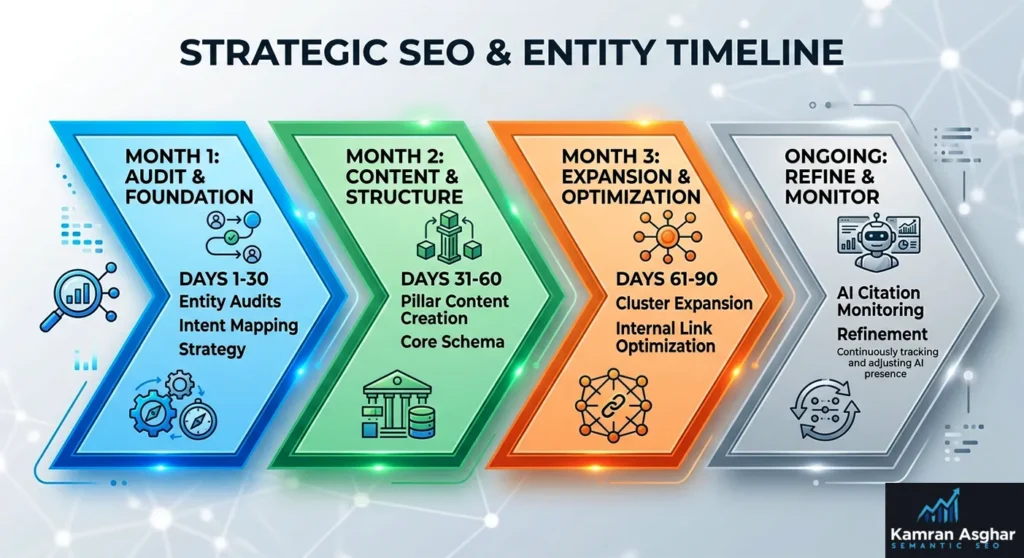
Days 1-30: Foundation and Strategy
Days 1 through 30 focus entirely on strategy. Conduct your entity audit. Map search intent across your market. Plan your pillar-cluster architecture. Research semantic keywords and topic relationships. Do not write new content yet. Foundation determines everything that follows.
Days 31-90: Creation and Expansion
Days 31 through 60 shift to creation. Build your first pillar page — the most comprehensive resource you have ever produced on your core topic. Develop the first three to five cluster pieces that support it. Implement schema markup on these pages. Establish your internal linking architecture.
Days 61 through 90 expand and measure. Complete the initial cluster set. Build internal links between related cluster pieces. Establish measurement baselines for topical coverage, entity recognition, and engagement metrics. Begin planning your second pillar cluster.
Months 4-12: Refinement and Dominance
Months 4 through 6 bring refinement. Analyze which content performs against semantic KPIs. Expand successful clusters. Prune or improve underperforming pieces. Optimize for AI citations based on emerging data.
Month 6 through 12 establishes dominance. With multiple pillar clusters live, you should see significant ranking improvements for broad topical queries. Your site becomes the reference point that competitors struggle to displace.
Frequently Asked Questions
How long before semantic SEO shows results?
Typically three to six months for established sites with existing authority. New sites or those with significant technical debt may require six to twelve months. The timeline depends on your competitive landscape, content velocity, and how thoroughly you implement the framework. Early signals appear as increased impressions for related queries you did not explicitly target.
Can I implement semantic SEO on an existing site or only new ones?
Existing sites often have advantages like established authority, backlink profiles, and indexed content. The process involves auditing current content for entity coverage, restructuring information architecture where possible, and building new cluster content around existing pillars. It is rarely necessary to start from scratch.
How does semantic SEO differ from technical SEO?
Technical SEO focuses on infrastructure like crawlability, indexation, site speed, and mobile rendering. Semantic SEO focuses on meaning like entity relationships, content structure, and knowledge graph integration. You need both. Technical SEO ensures search engines can access your content. Semantic SEO ensures they understand it once accessed.
Should I hire a semantic SEO consultant or do this in-house?
The decision depends on your team’s expertise and bandwidth. Semantic SEO requires knowledge of natural language processing, structured data implementation, and content strategy architecture. If your team lacks experience in these areas, a consultant accelerates implementation and prevents costly mistakes. If you have strong technical and content capabilities, the framework above provides the roadmap for in-house execution.
Final Words
Implementation transforms semantic SEO from concept to competitive advantage. The businesses that build this infrastructure now will dominate search for years. Those that delay will find the knowledge graph increasingly crowded, with established entities difficult to displace.
If you need professional support implementing this framework, I offer professional semantic SEO Implementation services that include entity audits, topical map development, and content engineering. The systematic approach outlined here has generated consistent results across B2B, e-commerce, and publishing verticals.
Start your entity audit this week. Map one pillar topic completely. Build the first cluster piece. The search engines are already moving toward semantic understanding. Your implementation determines whether they see you as an authority or an afterthought.