
Kamran Asghar

I’m Kamran Asghar—an SEO consultant, digital marketer, and copywriter who’s been in the trenches of online marketing long enough to see Google flip the script more times than I can count. I don’t just talk SEO; I live it, breathe it, and—let’s be real—occasionally rant about it when an algorithm update wrecks months of work. I run KamranAsghar.com, where I help businesses rank higher, get more traffic, and actually make money online—because, let’s face it, what’s the point of being #1 on Google if your content reads like a robot wrote it? (Ironically, a lot of it is written by robots these days, but that’s another discussion.) Why Listen to Me? Because I’ve been in your shoes. I’ve built sites from scratch, watched them tank after bad SEO advice, and figured out what actually works (hint: it’s not stuffing keywords like it’s 2010). Whether it’s technical SEO, keyword research, or writing content that doesn’t put readers to sleep, I know how to make Google happy without sacrificing the human touch. I’ve worked with startups, entrepreneurs, and big brands, helping them navigate the SEO jungle. My specialty? Finding those sneaky ranking opportunities that most people overlook and turning bland, forgettable websites into traffic magnets. No Fluff, Just Results I don’t believe in generic, cookie-cutter SEO advice. I break things down so you actually understand what’s happening behind the scenes—no jargon, no BS. When I’m not reverse-engineering Google’s black box, I’m writing about SEO strategies, digital marketing trends, and copywriting hacks that actually move the needle. Want to rank higher, write better, or just vent about Google updates? Let’s talk.

Kamran Asghar

SEO Audit Report: What It Includes and How to Create One

Your website might have hundreds of pages, but not every page performs equally. Some pages attract organic traffic. Others struggle with indexing, rankings, or search visibility. An SEO audit report helps you understand what’s happening beneath the surface. It identifies website problems, explains their impact, and recommends practical improvements. But here’s the important distinction. A

SEO Audit Report: What It Includes and How to Create One Read More »
What Is AEO? Answer Engine Optimization Explained With Real Examples

Your content ranks number one. The traffic graph looks healthy. And yet, your brand is invisible where search is actually happening. Users ask ChatGPT for recommendations. They get answers from Google’s AI Overviews. They hear responses from voice assistants. In all these contexts, your competitors appear. You do not. Your traditional SEO success has become

What Is AEO? Answer Engine Optimization Explained With Real Examples Read More »

Semantic SEO vs Traditional SEO: Why Your Keyword Strategy Is Building on Sand

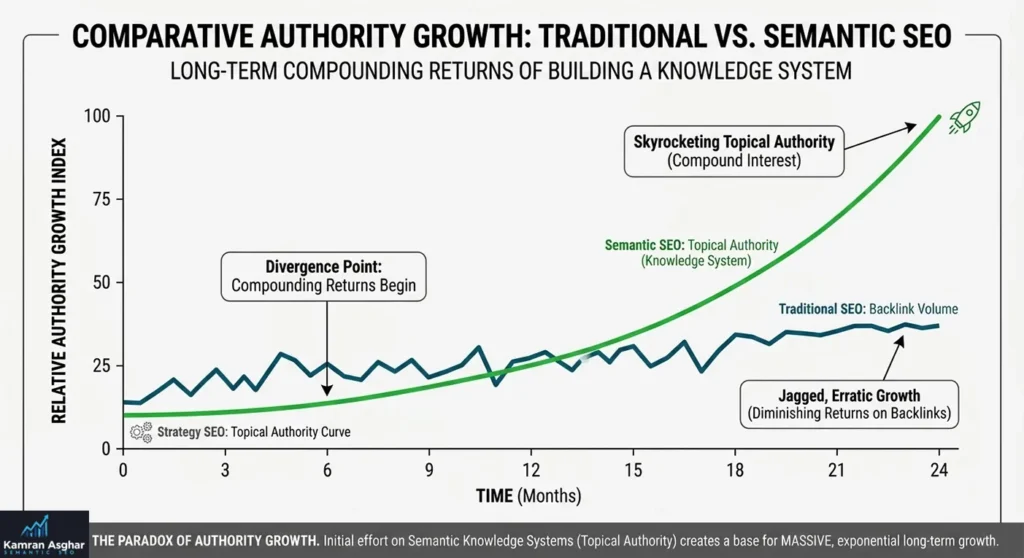
A chart showing two lines: one for Traditional SEO (flat, linear growth) and one for Semantic SEO (exponential, compounding growth).

You have optimized every page. The keywords are researched, placed, and tracked. Your backlink profile grows monthly. And yet, a competitor with half your domain authority just captured the featured snippet you targeted for six months. They did not outspend and outwork you. They understood something you missed: Google stopped matching keywords years ago. It

Semantic SEO vs Traditional SEO: Why Your Keyword Strategy Is Building on Sand Read More »

What Is a Content Brief? Definition, Components & Real-World Examples

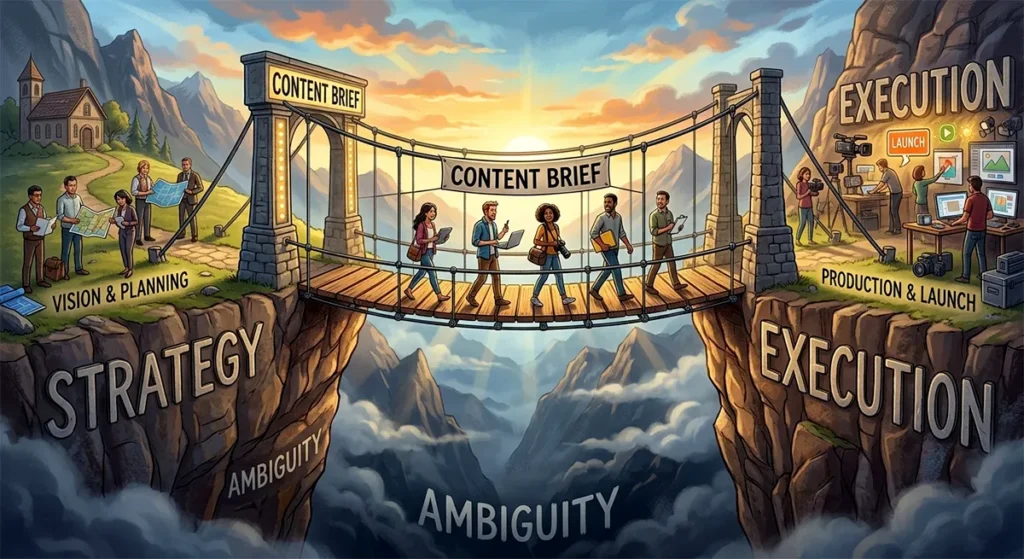
Conceptual illustration of a content brief acting as a bridge between strategy and execution over a canyon of ambiguity.

Stop me if this sounds familiar. Your writer delivers a draft. It is well-written. Grammatically perfect. Structurally sound. And completely wrong. They missed the search intent, and addressed the wrong audience segment. They ignored the competitive angle you discussed. Now you face a choice: publish suboptimal content or delay the project for revisions that blow

What Is a Content Brief? Definition, Components & Real-World Examples Read More »

What Is a Topical Map? SEO Structure, Components and Real-World Examples

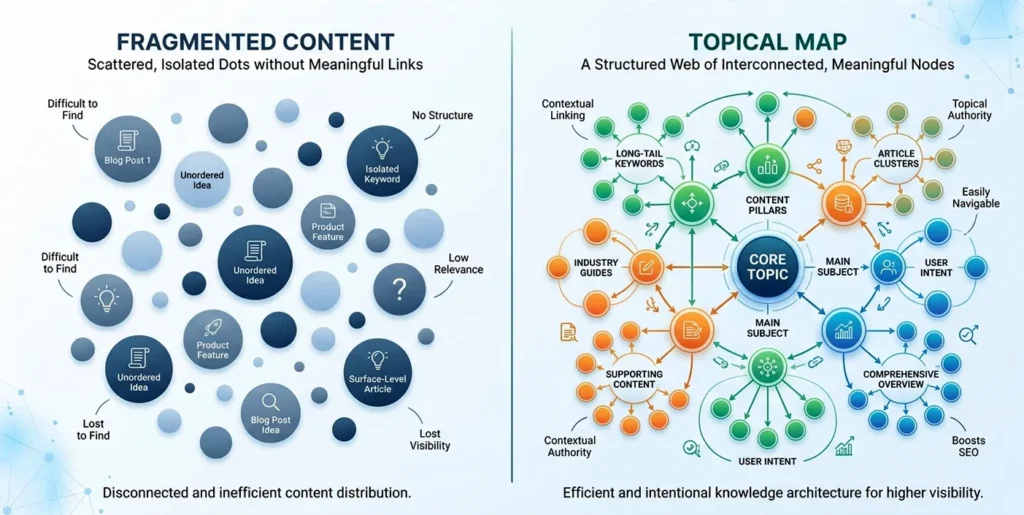
Diagram comparing scattered content pieces to a structured interconnected topical map network.

Most websites publish content into a void. They write articles, optimize pages, and build links. Then they wonder why their traffic charts look like heart rate monitors, spiking and crashing with every algorithm update. The problem is not their tactics but the architecture. They are building without a blueprint, creating isolated pieces that compete with

What Is a Topical Map? SEO Structure, Components and Real-World Examples Read More »

Entity-Based SEO: What It Is and How to Implement It

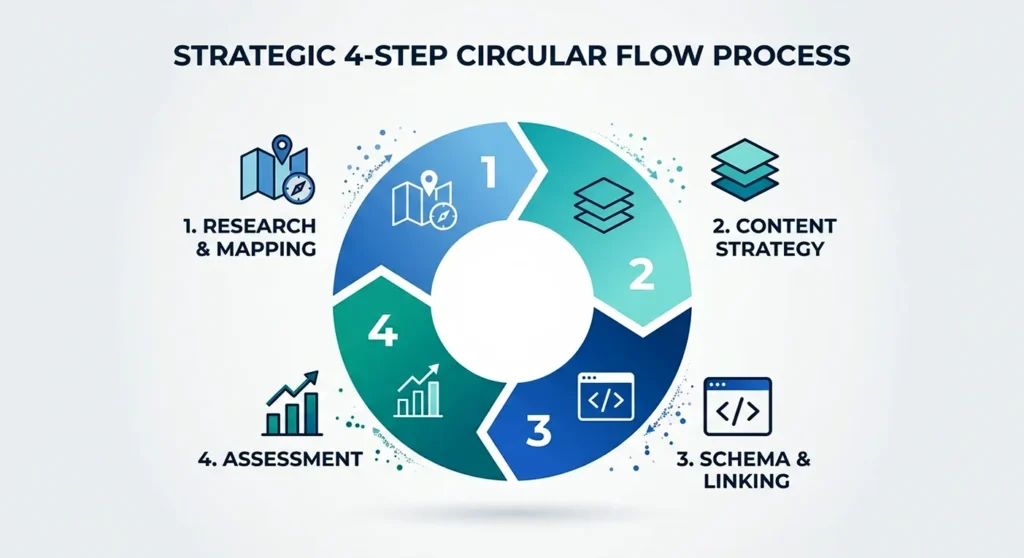
A circular flow diagram showing the four phases of entity optimization: Research & Mapping, Cluster Building, Schema Implementation, and Performance Assessment.

Entity-based SEO is an approach to search engine optimization that focuses on recognizable people, organizations, products, places, and concepts—and the relationships between them. Instead of treating every keyword as an isolated target, it helps you plan content around the subject, its attributes, and the questions people ask about it. For example, a website about project

Entity-Based SEO: What It Is and How to Implement It Read More »

How to Implement Semantic SEO: A 5-Step Framework for 2026

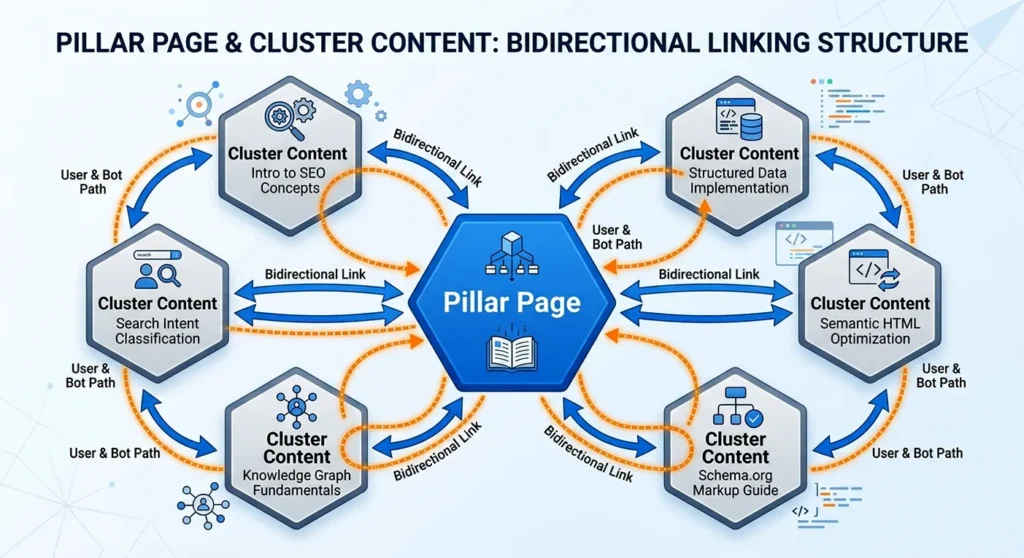
A technical infographic of the pillar-cluster model, showing a central pillar page connected via bidirectional internal links to multiple specific cluster content pages to build topical authority.

You understand what semantic SEO means. You have seen how it differs from traditional keyword optimization. Now you need to build it. Implementation separates theory from results. I have watched businesses spend months discussing semantic concepts while their competitors capture the rankings, the traffic, and the revenue. The gap is not knowledge but execution. Semantic

How to Implement Semantic SEO: A 5-Step Framework for 2026 Read More »

What Is Semantic SEO? Definition, Examples & Implementation Framework

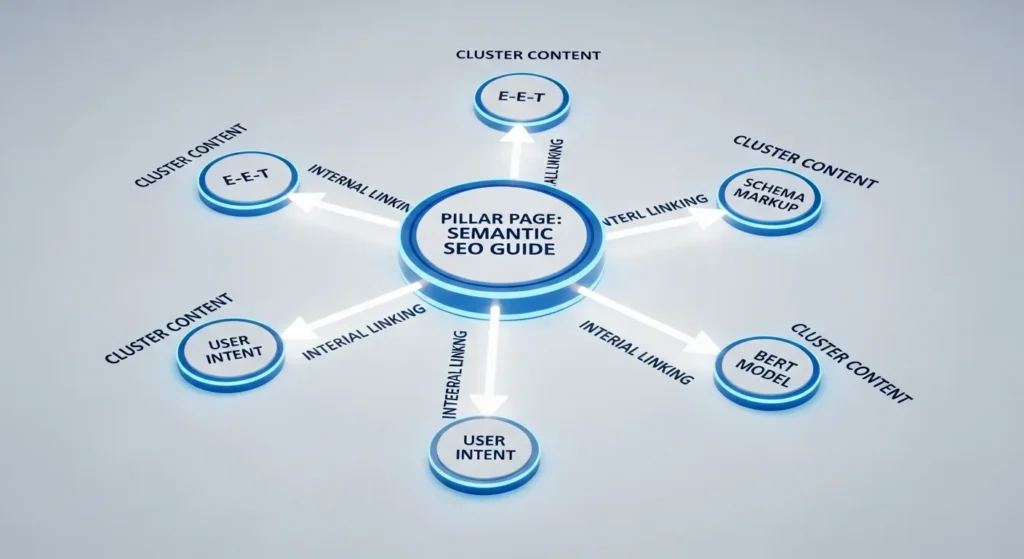
A simplified hub-and-spoke diagram showing a large central node labeled 'Pillar Page (Semantic SEO)' connected by interlinking lines to four smaller surrounding nodes labeled 'Cluster Content' (e.g., Schema, E-E-A-T, BERT).

Stop optimizing for keywords. Start optimizing for meaning. That single shift represents the most important evolution in search engine optimization since Google launched in 1998. Yet most businesses still approach SEO the same way they did a decade ago—chasing individual keywords, stuffing pages with exact-match phrases, and wondering why their rankings vanish with every algorithm

What Is Semantic SEO? Definition, Examples & Implementation Framework Read More »

The 5 P’s Audit: Elevating Your Business with Strategic SEO

The 5 P's Audit for Maximizing Your Business' Digital Strategy and ROI

By Kamran Asghar, SEO Strategy Consultant After Google’s October update, SEO is not a checklist of keywords; it is a strategic business asset that drives growth. Just as a business owner must audit their corporate apparel for quality, you must audit your digital presence for strategic alignment. I’ve structured this 5 P’s Strategic SEO Audit

The 5 P’s Audit: Elevating Your Business with Strategic SEO Read More »

Mini Chatbot

Wait a moment

AI Chatbot
Offline