

Stop me if this sounds familiar.
Your writer delivers a draft. It is well-written. Grammatically perfect. Structurally sound. And completely wrong.
They missed the search intent, and addressed the wrong audience segment. They ignored the competitive angle you discussed. Now you face a choice: publish suboptimal content or delay the project for revisions that blow your timeline and budget.
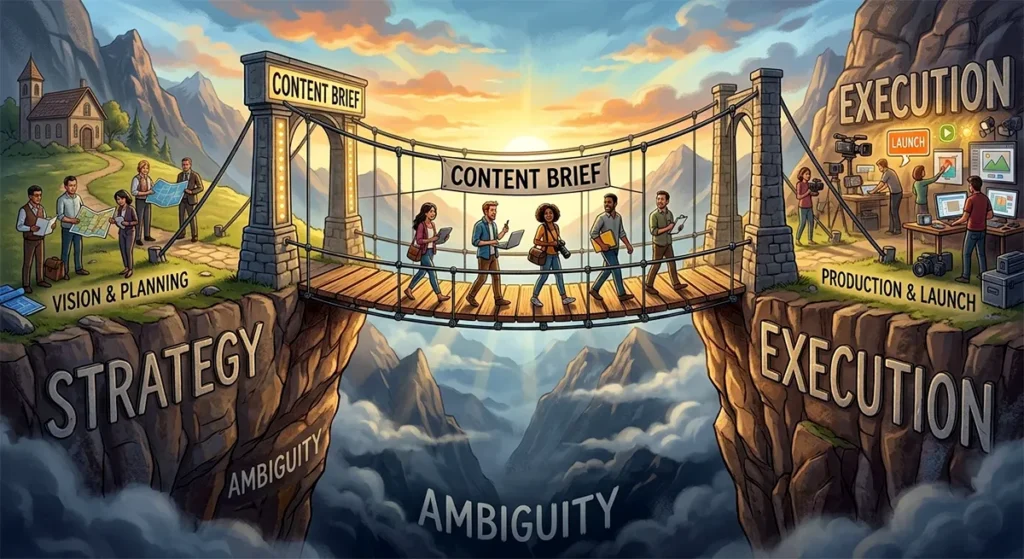
This scenario plays out in marketing departments every day. The root cause is not writer incompetence. It is communication failure. Strategy exists in the strategist’s head. Execution happens in the writer’s hands. The gap between them is where good content dies.
A content brief closes that gap. It is not administrative paperwork. It is strategic architecture that transforms business objectives into executable guidance. When done well, it eliminates ambiguity, accelerates production, and produces content that performs. When skipped, it guarantees inefficiency and mediocrity.
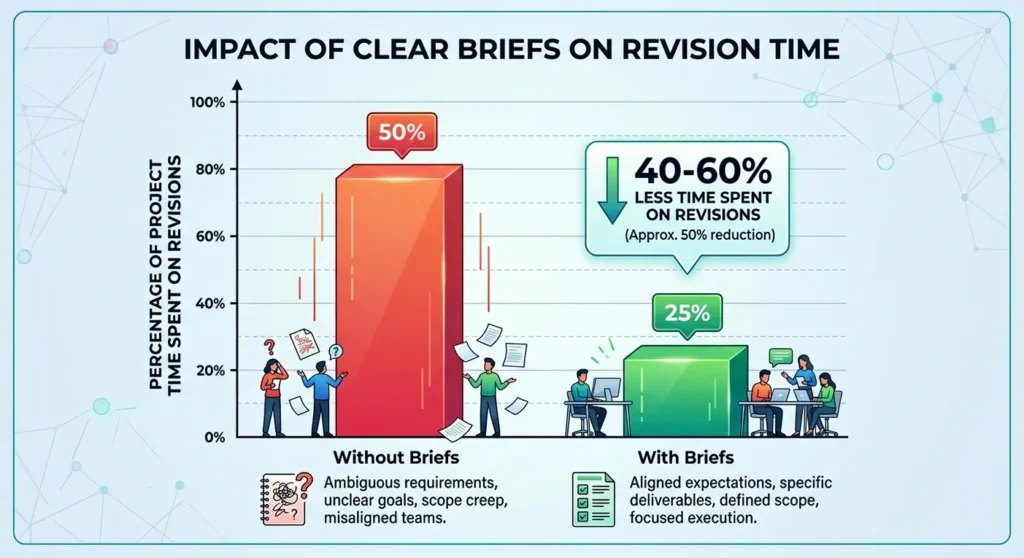
I have developed content briefs for B2B technology companies, SaaS platforms, and professional service firms across the US, UK, and Canada. The pattern is consistent: organizations that implement systematic briefing reduce revision cycles by forty to sixty percent. Their content aligns with business goals. Their writers spend time creating rather than guessing.
Let me show you exactly what a content brief is, why it matters, and how to build one that produces results.
What Is a Content Brief?
A content brief is a strategic document that guides content creation by defining purpose, audience, structure, and success criteria. It sits at the intersection of business objectives and creative execution, translating marketing goals into actionable guidance for writers, designers, and producers.
Content briefs build upon semantic seo fundamentals—the broader practice of optimizing for meaning, context, and user intent rather than isolated keywords. Just as semantic SEO requires understanding entities and relationships, effective briefs require understanding how content elements connect to business outcomes.
Without a brief, content creation relies on assumption. Writers guess at intent. Designers interpret brand voice independently. Strategists hope the final output aligns with search goals. The result is predictable: multiple revision cycles, missed opportunities, and content that satisfies no one because it was built for everyone.
With a brief, every decision has justification. The target audience is defined not as “B2B buyers” but as “SaaS marketing directors at companies with fifty to two hundred employees, struggling with lead quality from organic search.” The content objective is specific: “Rank for ‘semantic SEO services’ and convert readers to consultation bookings.” The structure is predetermined: “Open with problem agitation, present framework, provide case study, close with soft CTA.”
This precision matters. Research consistently shows that detailed content briefs reduce revision cycles by 40 to 60 percent. They eliminate the ambiguity that destroys deadlines and budgets. They create accountability by establishing clear success criteria before production begins.
If your organization lacks the internal resources to develop this level of strategic documentation, professional content brief services can provide the systematic approach that transforms content operations from chaotic to predictable.
Why Content Briefs Matter for Modern Marketing
Modern content marketing operates at scale. Enterprises publish hundreds of pieces monthly. Agencies manage dozens of clients. Freelancers juggle multiple projects. Without systematic briefs, quality becomes inconsistent, brand voice fragments, and strategic goals dissolve in the rush to publish. According to Content Marketing Institute, 63 percent of B2B marketers use content briefs to guide creation, yet only 28 percent report those briefs as ‘highly effective.
The Cost of Poor Briefing
Poor briefing carries measurable costs that compound across content operations. Revisions consume thirty to fifty percent of content production time when briefs are inadequate or absent. Misaligned content requires complete rewrites rather than refinements, destroying timelines. Missed SEO opportunities mean content that never ranks, regardless of writing quality, because search requirements were never specified. These costs multiply across content volume, turning ambitious strategies into operational nightmares that drain resources and demoralize teams.
The Advantage of Precision
Detailed briefs create competitive advantage that extends beyond individual pieces. They enable consistent quality across distributed teams working in different time zones and cultural contexts. They preserve institutional knowledge when strategists change roles or agencies switch vendors. They create audit trails for content performance, linking specific brief elements to results so teams learn what works. Most importantly, they allow strategists to focus on strategy rather than firefighting production issues that should have been prevented.
Christopher Davis, Head of Content Operations at a B2B technology firm, noted: “The content briefs he developed were a game-changer. They saved our writing team fifty percent of their research time and, for the first time, our content was truly aligned with our topical authority.” This testimonial reflects a pattern I see consistently: organizations that implement systematic briefing outperform competitors still relying on ad hoc communication and assumed understanding.
Essential Components of a Content Brief
A comprehensive content brief contains specific elements that eliminate ambiguity and guide execution. Each component serves a distinct purpose in the content creation workflow, creating a complete picture that writers can execute against.
Strategic Foundation
The strategic foundation includes content objective, target audience, and success metrics. The objective defines what the content must achieve: awareness, consideration, conversion, or retention. Specificity matters here. “Increase organic traffic” is vague and unactionable. “Rank for ‘content brief template’ and generate five hundred monthly visits with three percent conversion to trial signup” provides clear direction and measurable outcomes.
The audience segment goes beyond demographics to psychographics and pain points. Who are they? What is their current state? What problem are they trying to solve? What information do they need to move to the next stage? Audience research might include survey data, sales call recordings, support ticket analysis, or interview transcripts that reveal language patterns and emotional triggers.
Success metrics specify how performance will be measured: organic traffic, conversion rate, engagement time, backlink acquisition, or social shares. These metrics connect the content piece to business outcomes, ensuring creative work serves strategic goals.
SEO Specifications
SEO specifications integrate search strategy into creative work. Primary and secondary keywords establish topical focus and entity relationships. Search intent classification ensures content matches user expectations—informational queries need comprehensive answers, transactional queries need conversion paths. Competitor analysis identifies content gaps and differentiation opportunities so you do not merely replicate what ranks but improve upon it. Internal linking requirements specify connections to existing content architecture, building topical authority through strategic relationships.
For organizations implementing implementation framework for semantic content, SEO specifications in briefs must include entity mapping, semantic keyword groups, and structured data requirements that align with broader topical authority strategies.
Content Architecture
Content architecture defines structure before writing begins. Recommended word count sets scope expectations and resource requirements. Suggested headings provide narrative flow without scripting every sentence—guidance that shapes direction while preserving creative autonomy. Content format specifies whether the piece will be a guide, comparison, case study, thought leadership, or product focus. Required elements might include data visualizations, expert quotes, original research, or specific examples that strengthen authority.
Brand and Creative Guidelines
Brand guidelines ensure consistency across distributed production. Voice and tone specifications adapt brand personality to the specific audience and context—a technical guide requires different expression than an executive thought piece. Style preferences cover formatting, citation requirements, and prohibited phrases or approaches. Visual direction guides designers or specifies image requirements for writers sourcing visuals, ensuring aesthetic coherence.
Production Logistics
Production logistics keep projects on track and accountable. Deadlines include draft, revision, and final delivery dates with buffer time for unexpected complications. Review process identifies stakeholders and approval requirements, preventing last-minute surprises from overlooked decision-makers. Asset requirements list supporting materials needed: research reports, product screenshots, expert interview access, or proprietary data that must be incorporated.
Content Brief vs Content Outline: Critical Distinction
These terms are usually conflated, but they serve different purposes at different stages of content development. Understanding the distinction prevents workflow confusion and ensures teams use the right tool for the right job.
A content outline is a structural skeleton. It lists sections and subsections, perhaps with bullet points for key points under each heading. It answers “what goes where” from an organizational perspective. An outline is typically created by the writer during the drafting process, or provided as minimal guidance when the strategic direction is already well understood.
A content brief is strategic architecture. It includes the outline’s structural guidance but adds audience analysis, competitive positioning, SEO requirements, brand voice specifications, and success criteria. It answers “why this content, for this audience, in this format, at this time.” A brief is created by strategists before writer assignment and governs the entire production process, from conception through publication and measurement.
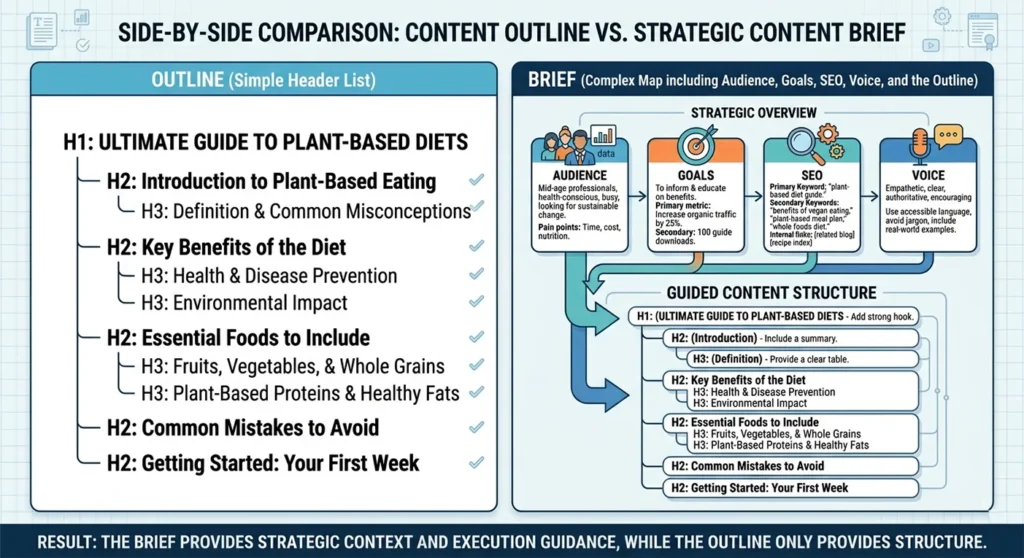
The distinction matters for workflow efficiency. Outlines alone leave writers guessing at intent and context. Briefs alone can feel prescriptive to experienced writers who prefer structural flexibility. The best approach combines both: a comprehensive brief for strategic alignment, with collaborative outline refinement between strategist and writer that respects creative expertise while maintaining strategic integrity.
To Improve your workflow efficiency, see our complete content brief versus content outline comparison
Types of Content Briefs by Use Case
Different content types require different brief structures. One template cannot serve all purposes effectively. Understanding these variations ensures you apply the right framework to the right challenge.
SEO Content Briefs
SEO content briefs prioritize search performance and topical authority. They emphasize keyword intent, SERP feature opportunities, topical depth requirements, and internal linking architecture that builds entity relationships. These briefs often run eight to twelve pages, with extensive competitor analysis and semantic keyword mapping. The goal is not just ranking but owning the conversation around a topic cluster.
For teams seeking efficiency, a downloadable seo content brief template can provide the structured foundation that ensures consistent SEO integration without reinventing the framework for every piece.
Editorial Content Briefs
Editorial briefs focus on narrative and engagement rather than search metrics. They emphasize story angle, source requirements, tone specifications, and publication standards. These briefs are common in journalism, thought leadership, and brand storytelling contexts where originality and perspective matter more than keyword optimization.
Creative Briefs
Creative briefs guide visual and multimedia content. They emphasize concept, mood, audience emotional response, and brand expression. These briefs are typical for video production, advertising campaigns, interactive content, and experiential marketing where the sensory experience carries the message.
Product Content Briefs
Product briefs support commercial content with conversion focus. They emphasize value propositions, competitive differentiation, use cases, and conversion paths. These briefs are essential for e-commerce, SaaS, and technology marketing where content must educate and persuade simultaneously.
How to Create Content Briefs: The 8-Step Framework
Systematic brief creation ensures consistency and completeness. This framework scales from individual creators to enterprise teams, providing repeatable structure that improves with each iteration.
Step 1 – Define Content Objective
Start with business impact. What must this content achieve? Objectives fall into four categories: attract (awareness), engage (consideration), convert (transaction), or retain (loyalty). Specificity matters more than category. “Increase organic traffic” is vague. “Rank for ‘content brief template’ and generate five hundred monthly visits with three percent conversion to trial signup” is actionable and measurable.
Step 2 – Research Target Audience
Go beyond demographics to psychographics. What is the reader’s current state? What problem are they trying to solve? What information do they need to move to the next stage? Audience research might include survey data, sales call recordings, support ticket analysis, or direct interviews that reveal language patterns, emotional triggers, and decision criteria.
Step 3 – Analyze Search Intent
For SEO content, intent analysis is non-negotiable. Examine current SERPs for target queries. What content formats rank? What questions appear in People Also Ask? What entities dominate the results? This analysis determines whether your content can compete and how it must differentiate to earn placement.
Step 4 – Map Content Structure
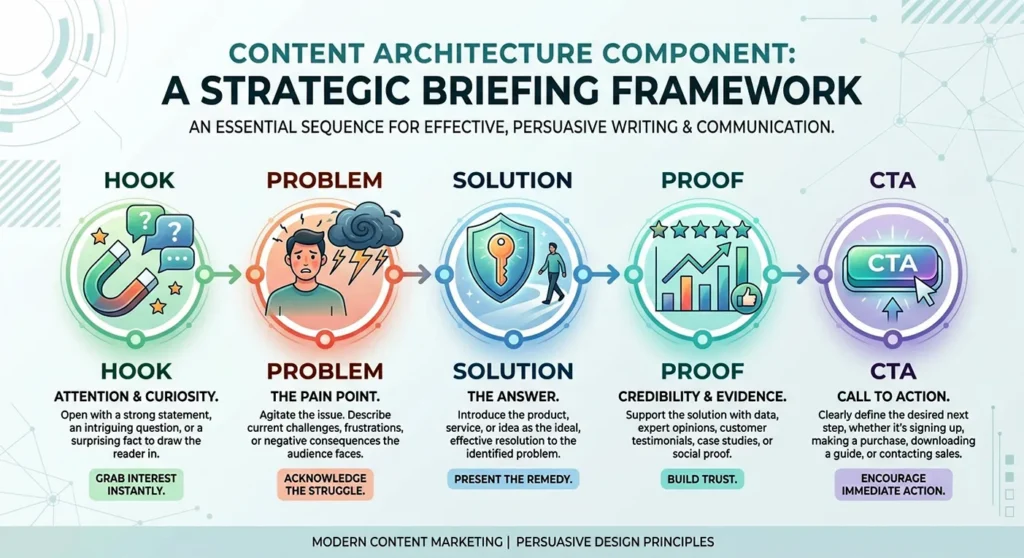
Define the narrative arc that guides readers from problem to solution. Opening hook establishes relevance and credibility. Problem agitation creates urgency and emotional investment. Solution presentation builds authority through framework or methodology. Proof elements overcome skepticism with data, case studies, or testimonials. Call to action converts interest into measurable next steps. Each section needs purpose, not just presence.
Step 5 – Specify SEO Requirements
Document keyword targets, semantic keyword groups, title tag recommendations, meta description guidance, and internal linking targets. Include schema markup suggestions where relevant—Article, FAQPage, HowTo, or other structured data that enhances search visibility.
Step 6 – Establish Brand Guidelines
Define voice characteristics, tone adaptations for this specific audience, and style preferences. Reference existing brand guidelines rather than duplicating them, ensuring consistency without unnecessary documentation.
Step 7 – Set Production Parameters
Specify word count, deadline, review stages, and asset requirements. Include contingency plans for scope changes or timeline shifts, preventing crisis when complications arise.
Step 8 – Validate Brief Completeness
Review the brief against a checklist. Does it answer every question a writer might have? Does it align with strategic goals? Does it provide sufficient guidance without excessive prescription that stifles creativity? This validation step prevents the brief itself from becoming a bottleneck.
For comprehensive guidance on execution, see our detailed content brief writing methodology that expands each step with specific tools and validation techniques.
Content Brief Examples: 3 Real-World Briefs
Abstract frameworks become concrete through examples. These three briefs illustrate how the components come together for different content types.
Example 1: B2B SEO Blog Post Brief
A brief for “What Is Semantic SEO?” targeting marketing directors at mid-market SaaS companies. Strategic objective: establish topical authority and generate consultation bookings. SEO specifications include primary keyword “what is semantic seo,” secondary keywords “entity based seo” and “semantic search optimization,” target word count 2,800, and required schema markup Article and FAQPage. Structure includes problem statement, definition section, comparison with traditional SEO, implementation framework, case study, and conversion-focused conclusion. Brand voice: authoritative but accessible, engineering-informed but not technical. Success metric: rank within top 5 and generate 10+ consultation requests monthly.
Example 2: Product Page Brief
A brief for SaaS landing page targeting “project management software for construction.” Audience: operations managers at construction firms with 50-200 employees. Objective: generate demo requests. Structure emphasizes industry-specific pain points (subcontractor coordination, permit tracking, mobile field access), feature-benefit mapping, social proof from construction clients, and risk reversal guarantees. SEO requirements include Product schema, Review schema, and comparison table markup. Production requirements: 1,500 words, video testimonial, interactive feature demo, two-week timeline.
Example 3: Thought Leadership Brief
A brief for executive byline on “Future of AI in Content Marketing.” Audience: CMOs at enterprise organizations. Objective: brand awareness and executive positioning for speaking opportunities. Structure emphasizes original research from proprietary data, contrarian perspective on AI limitations, and actionable predictions for 2026. Minimal SEO focus beyond entity mentions and authoritative tone. Success metric: publication in Tier 1 outlet and 50+ LinkedIn shares by target audience.
For additional formats and industry variations, explore our real-world content brief examples covering e-commerce, healthcare, and financial services applications.
Common Content Brief Mistakes
Even experienced strategists undermine their briefs with predictable errors that reduce effectiveness and create friction in the production process.
- Vague objectives produce generic content that serves no specific purpose. “Create something engaging” provides no direction for writers who need to understand what success looks like. Specific outcomes enable specific execution.
- Insufficient audience research results in content that addresses everyone and resonates with no one. Briefs need audience specificity that writers can internalize and embody in their work.
- Over-prescription stifles creativity and produces mechanical content. Briefs should guide, not script. Experienced writers need room to adapt structure and find their own expression within strategic constraints.
- Missing SEO integration creates beautiful content that never ranks because search requirements were never specified. SEO must be built into briefs from the start, not added as afterthoughts when content fails to perform.
- Ignoring production constraints leads to deadline failures and quality compromises. Briefs should acknowledge resource limitations and timeline realities, setting achievable expectations.
Measuring Content Brief Effectiveness
Quality briefs produce measurable outcomes that justify the investment in strategic documentation. Track revision rates: well-briefed content requires fewer rounds of feedback and refinement. Monitor production time: clear briefs accelerate drafting by eliminating research gaps and directional uncertainty. Measure strategic alignment: does final content achieve stated objectives, or did execution drift from intent?
Most importantly, correlate brief elements with performance data. Which brief components predict ranking success? Which audience definitions correlate with engagement and conversion? Which content structures produce the desired actions? This analysis refines brief templates over time, creating institutional knowledge about what works for your specific audience and goals.
FAQs
What is the difference between a content brief and a creative brief?
A content brief guides written content with emphasis on structure, SEO, and information architecture. A creative brief guides visual or multimedia content with emphasis on concept, mood, and emotional response. They share strategic foundation but differ in execution details.
How long should a content brief be?
SEO content briefs typically run 8-12 pages for comprehensive pieces. Editorial briefs might be 2-4 pages. The length depends on content complexity, writer experience, and strategic stakes. Brevity is valuable, but completeness matters more.
Who should write the content brief?
Strategists, content managers, or SEO specialists typically write briefs. Subject matter experts may contribute technical details. The brief writer needs understanding of business goals, audience needs, and search dynamics.
Can AI write content briefs?
AI can assist with research, structure suggestions, and competitive analysis. Human judgment remains essential for strategic decisions, audience understanding, and creative direction. The best approach combines AI efficiency with human expertise.
How detailed should SEO specifications be?
Detailed enough that writers understand intent, entities, and relationships without being overwhelmed. Primary and secondary keywords, search intent classification, competitor differentiation angles, and internal linking targets are essential. Raw keyword lists without context are insufficient.
What makes a content brief effective?
Clear objectives, specific audience definition, actionable structure, integrated SEO requirements, and measurable success criteria. An effective brief answers every question a writer might have before they need to ask it.
Final Words
Content briefs are not bureaucratic overhead. They are strategic infrastructure that separates professional content operations from amateur efforts. The organizations that master briefing scale efficiently. Those that skip it struggle with quality, consistency, and performance.
The investment in brief creation pays dividends across every subsequent content piece. Better briefs mean fewer revisions, faster production, stronger performance, and more predictable outcomes. In an environment where content volume increases while attention spans decrease, precision matters more than ever.
If you need support developing systematic content briefs that align with semantic SEO strategy and business objectives, I offer professional content brief services that include template development, team training, and ongoing quality assurance.
Start with one brief this week. Define the objective precisely. Research the audience deeply. Specify the structure clearly. Measure the results honestly. Build from there.