

Most websites publish content into a void. They write articles, optimize pages, and build links. Then they wonder why their traffic charts look like heart rate monitors, spiking and crashing with every algorithm update.
The problem is not their tactics but the architecture. They are building without a blueprint, creating isolated pieces that compete with each other rather than a cohesive system that compounds in value.
A topical map is that blueprint. It is the cartography of expertise, plotting the terrain of your knowledge domain so search engines recognize you as the definitive source. With a proper map, every piece of content reinforces every other piece. Without one, you are wandering.
I have built topical maps for B2B companies across the US, UK, and Canada. The pattern is consistent: sites that implement systematic topical architecture see sustainable traffic growth that withstands algorithm shifts. They outrank competitors with ten times their domain authority. They get cited by AI systems as authoritative sources. Their competitors, still chasing individual keywords, cannot understand why their tactics stopped working.
Let me show you exactly what a topical map is, why it matters, and how to build one that establishes genuine authority.
What Is a Topical Map?
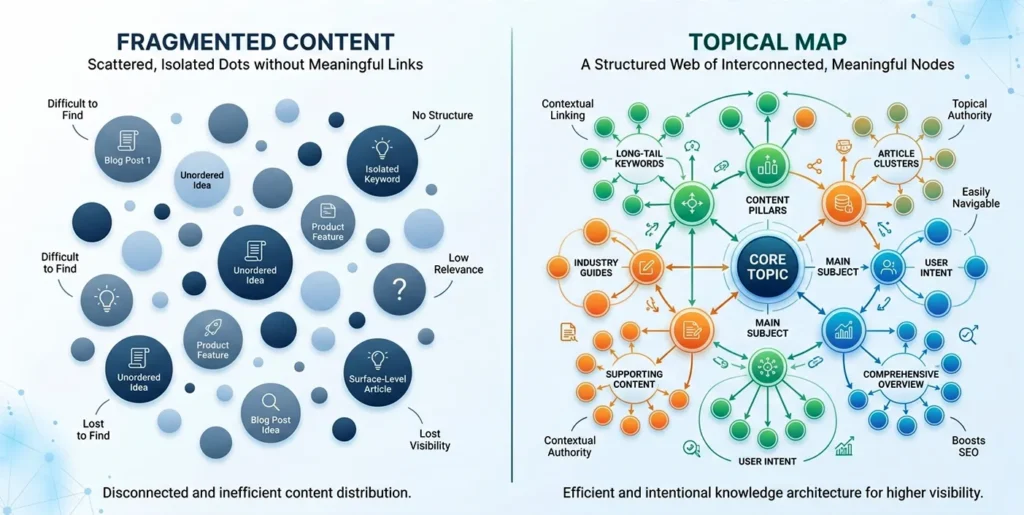
A topical map is a content architecture that organizes entities, topics, and relationships into interconnected clusters designed to establish search engine authority. It is the engineering drawing for your content ecosystem, showing how every piece connects to every other piece to create a web of meaning.
Without a topical map, content production is reactive. You target keywords as they emerge, publishing isolated articles that compete with each other for attention and rankings. Your site becomes a collection of pages rather than an authoritative resource. Search engines struggle to understand your expertise because you have not defined the boundaries and depth of your knowledge.
With a topical map, every content decision is intentional. You identify core entities that define your expertise. You map the relationships between those entities, which concepts are foundational, which are applications, which are comparisons and alternatives. You build content clusters that cover each entity comprehensively, creating semantic density that search engines cannot ignore.
The result is topical authority. Google does not just rank your individual pages highly. It recognizes your site as the primary source for entire categories of queries. This authority is durable. Algorithm updates that devastate keyword-focused sites barely touch topically authoritative ones because the authority derives from genuine expertise rather than tactical optimization.
For organizations ready to build this infrastructure, professional topical map development services provide the systematic approach that transforms content operations from chaotic to authoritative.
Why Topical Maps Matter for Modern SEO
Modern search has shifted from matching keywords to understanding topics. Topical maps align your content with this fundamental change in how search engines process information.
From Keywords to Topics: The Search Evolution
Google’s Hummingbird update in 2013 began the shift from keyword matching to topic understanding. BERT in 2019 enabled contextual comprehension of word relationships. Today, large language models process search queries by identifying entities and their connections, not by matching text strings. A topical map ensures your content exists in the same semantic space as these AI systems, making you eligible for citations and recommendations that drive visibility.
Research from 2025 shows that pages with high semantic alignment between content and meta descriptions receive up to 4.7 AI citations versus 4.1 for low-alignment pages. As search becomes increasingly AI-driven, topical authority determines whether you appear in AI-generated answers or remain invisible.
The Problem of Content Fragmentation
Most websites suffer from content fragmentation. They have dozens of articles targeting slight variations of the same keyword, each competing with the others for rankings. They have gaps where critical topics are never addressed. They have orphaned pages with no internal links, isolated from the site’s semantic structure. Topical maps solve fragmentation by design, ensuring comprehensive coverage with logical relationships that guide both users and search engines.
Competitive Moat Building
Topical authority creates defensive advantages that are difficult to replicate. Once established, competitors cannot simply write better individual articles to displace you. They must match your entire content ecosystem, a process that takes months or years of consistent investment. Your topical map becomes a protective barrier around your search visibility.
Topical Authority vs Domain Authority: Critical Distinction
These metrics measure different phenomena, and understanding the difference determines where you invest your resources.
Domain authority measures link-based strength. It predicts ranking potential based on the quantity and quality of backlinks to your site. High domain authority helps you rank, but it does not guarantee topical relevance. A site with high domain authority but thin topical coverage will lose to focused competitors for specific queries.
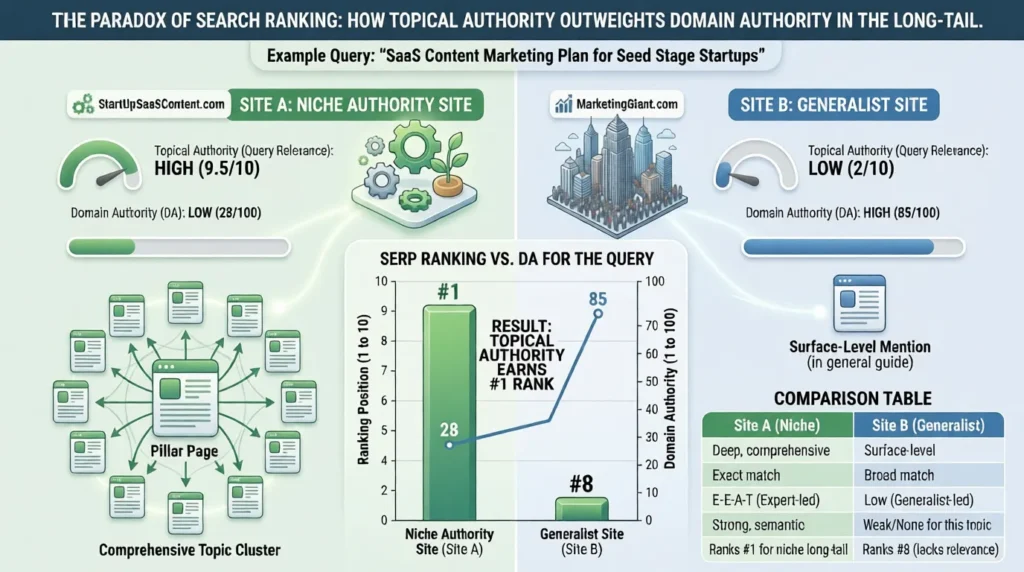
Topical authority measures expertise depth. It reflects how comprehensively you cover a subject area and how well search engines understand your entity relationships. A site with high topical authority can outrank much larger competitors for queries within its expertise area. This is how niche sites defeat major publishers like WebMD and Healthline.
The distinction matters for resource allocation. Link building improves domain authority. Content architecture and entity coverage build topical authority. Both matter, but topical authority is increasingly the limiting factor for sustainable rankings. You cannot link-build your way out of thin content that lacks genuine expertise.
Core Components of a Topical Map
A comprehensive topical map contains specific structural elements that guide content development and signal expertise to search engines.
Central Entity Definition
Every topical map centers on core entities that define your expertise. These are not keywords but concepts, distinct, well-defined ideas with attributes and relationships. “Semantic SEO” is an entity. “Content marketing” is an entity. Your topical map identifies five to ten core entities that represent your primary expertise areas, ensuring focus rather than fragmentation.
Pillar Pages as Authority Hubs
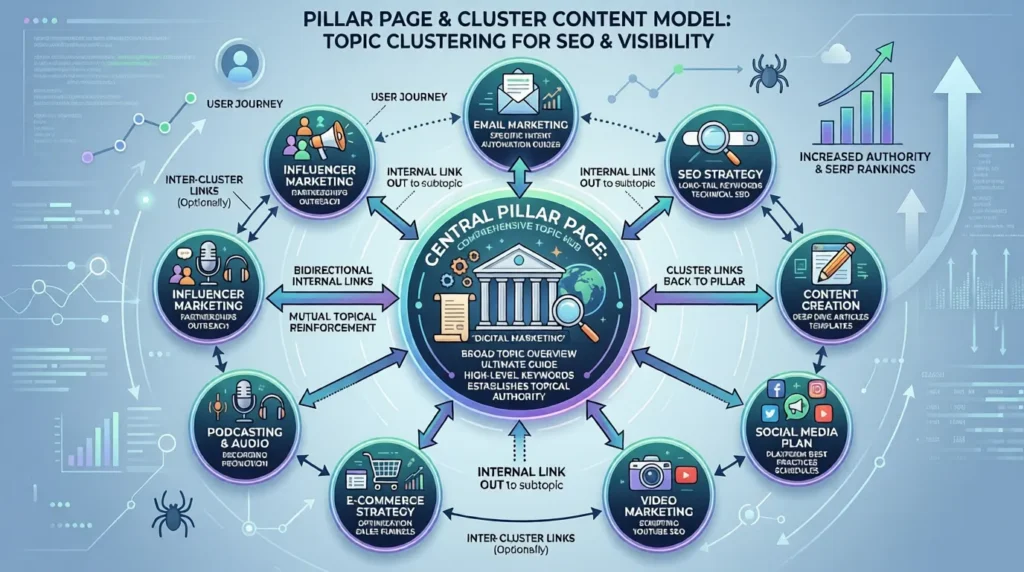
Each core entity gets a pillar page, a comprehensive resource covering the entity broadly. These pages typically run three thousand to five thousand words and serve as the definitive treatment of their topic. They link to all related cluster content and receive links back from those pieces, creating semantic density that search engines recognize as authority. For a detailed methodology on constructing these hubs, see our step-by-step topical map creation methodology.
Cluster Content Network
Cluster pages explore specific aspects, questions, and applications related to each pillar. They provide the depth that demonstrates genuine expertise. A pillar on semantic SEO might have cluster pages on entity optimization, schema markup, topical authority measurement, and AI citation optimization. Each cluster piece links to the pillar and to related clusters, weaving a web of meaning.
Semantic Relationship Mapping
Topical maps explicitly define how entities relate. Some entities are parent-child relationships. Some are comparisons. Some are sequential processes. These relationships determine internal linking architecture and content cross-references, creating pathways that search engines follow to map your knowledge domain.
Gap Analysis and Coverage Planning
Complete topical maps identify what is missing. Competitive analysis reveals which entities competitors cover that you do not. Search query analysis reveals which questions remain unanswered in your content. This gap analysis prioritizes future content development, ensuring your topical authority grows systematically rather than haphazardly.
How Topical Maps Build Search Authority
Topical authority emerges from specific signals that search engines use to evaluate expertise.
Comprehensive entity coverage demonstrates that you have explored a topic thoroughly, not just touched surface-level aspects. When your content addresses primary entities, related concepts, and edge cases, search engines infer genuine expertise rather than superficial targeting.
Semantic interconnection shows that you understand relationships between concepts. Internal links using descriptive anchor text create pathways that search engines follow to map your knowledge domain. The density and quality of these connections indicate expertise depth that isolated articles cannot match.
Consistent entity recognition across your site reinforces your topical focus. When search engines extract entities from your content and find the same concepts appearing repeatedly with consistent attributes, they gain confidence in your authority for those topics.
User engagement patterns validate topical authority. When visitors explore multiple pieces within your topic clusters, spending significant time and engaging deeply, search engines interpret these patterns as evidence of valuable expertise worth ranking prominently.
Real-World Topical Map Examples
Abstract concepts become concrete through examples of successful implementation.
Example 1: Health Information Site
A health information publisher built a topical map around “diabetes management” with pillar content covering the condition comprehensively. Cluster content addressed diet, exercise, medication, monitoring, and complications. The map included fifty cluster pieces supporting the pillar. Within six months, the site outranked WebMD and Healthline for dozens of queries, not because of higher domain authority, but because of superior topical depth. The topical map made their expertise undeniable.
According to a case study by Koray Tugberk Gubur, this pattern of outranking major medical publishers with focused topical authority has been replicated across health, finance, and technology verticals, demonstrating that depth defeats breadth when properly architected.
Example 2: B2B Software Company
A project management software company mapped their expertise around “project management methodology,” “team collaboration,” and “remote work management.” Each pillar connected to product features, use cases, and implementation guides. The topical map guided content creation for eighteen months, resulting in topical authority that generated forty percent of their qualified leads from organic search.
Example 3: Professional Services Firm
A legal services firm built topical authority around “employment law for startups.” Their map covered hiring, contracts, termination, compliance, and dispute resolution. By owning this specific topical space, they outranked generalist law firms ten times their size for queries within their expertise area.
How to Create a Topical Map: 6-Step Process
Systematic topical mapping follows a proven process that scales from small businesses to enterprise organizations. For a comprehensive framework that extends these basics, see our comprehensive topical authority framework.
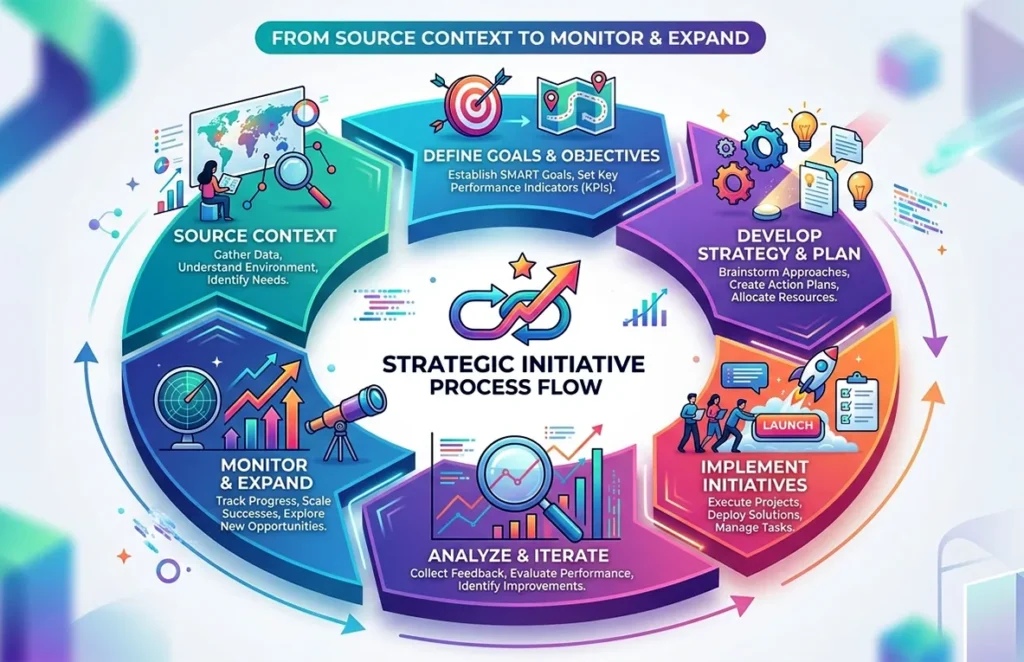
Step 1: Define Your Source Context
Establish your site’s core identity. What expertise do you legitimately own? What value do you provide? Who is your specific audience? This context determines which entities belong in your topical map and which do not, preventing dilution of focus.
Step 2: Identify Core Entities
Research the entities that define your space. Use Wikipedia, Wikidata, and Google’s Natural Language API to understand how knowledge bases structure your topics. Limit core entities to five to ten, enough to demonstrate expertise, few enough to maintain the focus that builds recognition.
Step 3: Map Entity Relationships
Define how your core entities connect. Which are foundational? Which are applications? Which are comparisons? This relationship mapping determines your content architecture and internal linking strategy, creating the semantic web that search engines traverse.
Step 4: Design Pillar-Cluster Architecture
For each core entity, design a pillar page and ten to twenty cluster pieces. Specify the angle, format, and unique value proposition for each piece. Ensure comprehensive coverage that leaves no critical gaps for competitors to exploit.
Step 5: Implement with Schema Markup
Build your content with structured data that makes entity relationships explicit. Use Article schema, FAQPage schema, and organizational markup that helps search engines parse your topical structure. For technical guidance, explore our entity optimization strategies that detail schema implementation.
Step 6: Monitor and Expand
Track topical authority signals: ranking breadth across related queries, AI citation rates, and engagement patterns within topic clusters. Expand your map as you establish authority in initial areas, building moats around your expertise.
Common Topical Map Mistakes
Even experienced SEO practitioners undermine their topical authority with predictable errors.
Treating topical maps as content calendars misses the strategic purpose. A map is architecture, not a publishing schedule. The relationships matter more than the volume or frequency of publication.
Creating isolated silos without cross-connection fails to build semantic density. Topical authority requires internal linking that weaves entities together into coherent knowledge structures that search engines can follow and understand.
Neglecting search intent alignment produces comprehensive content that does not satisfy users. Topical coverage must match what searchers actually want, not just what you want to say about your expertise area.
Overextending into weak expertise areas dilutes authority. Stay within domains where you have genuine depth. Topical authority cannot be faked, and attempts to cover too many topics result in shallow coverage that ranks for nothing.
Ignoring maintenance allows topical maps to decay as entities evolve. Regular audits identify gaps created by new competitor content or shifting search behavior, keeping your authority current.
Measuring Topical Authority Success
Topical authority produces specific metrics that indicate growing expertise recognition.
Ranking breadth across related queries shows topical expansion. When you rank not just for target keywords but for dozens of related terms you never explicitly targeted, your topical authority is working.
AI citation rates indicate that large language models recognize your expertise. Specialized tools now track how often AI systems reference your content for queries within your topic areas, a metric that will only grow in importance.
Knowledge Panel appearances for your brand signal entity recognition. When Google displays structured information about your organization, you have achieved topical entity status that differentiates you from competitors.
Engagement depth within topic clusters shows that users find your expertise valuable. Time on site, page depth, and return visits within topical areas all indicate that your authority translates into genuine user value.
FAQs
What is the difference between a topical map and a content calendar?
A content calendar schedules publication. A topical map architects relationships. The map determines what should exist; the calendar determines when to publish it.
How many pillar pages should a topical map include?
Most effective maps have five to ten pillar pages, each representing a core entity. Fewer limits your authority breadth. More dilutes your focus and resources.
Can small sites build topical authority?
Yes. Topical authority favors depth over scale. A small site with comprehensive coverage of a focused topic can outrank large sites with thin coverage across many topics.
How long does topical authority take to establish?
Expect six to twelve months for initial authority signals, eighteen to twenty-four months for dominant topical rankings. The timeline depends on content velocity, competitive density, and existing site authority.
Do topical maps work for local SEO?
Yes. Local topical authority focuses on geographic entities and service relationships. A local attorney might map entities around “DUI defense,” “personal injury,” and “family law” with location-specific cluster content.
How often should I update my topical map?
Quarterly audits identify gaps and opportunities. Major updates follow algorithm changes or competitive shifts. The map is a living document, not a one-time plan.
Final Words
Topical maps are not optional infrastructure for serious SEO. They are the foundation upon which sustainable authority is built. The businesses that implement systematic topical architecture now will dominate search for years. Those that continue publishing isolated articles will find themselves permanently outranked by competitors who understood that search has moved from pages to ecosystems.
The investment in topical mapping pays dividends across every content piece you create. Better architecture means better rankings, better user experience, and better protection against algorithm volatility. In an environment where AI systems increasingly determine visibility, topical authority is the price of admission.
If you need support developing systematic topical maps that align with semantic SEO strategy and business objectives, I offer professional topical map development services that include entity research, cluster architecture, and ongoing authority monitoring.
Start with entity identification this week. Map five core concepts that define your expertise. Build one comprehensive pillar page. Create the connections that search engines cannot ignore. The knowledge graph is waiting for your contribution.