

Stop optimizing for keywords. Start optimizing for meaning.
That single shift represents the most important evolution in search engine optimization since Google launched in 1998. Yet most businesses still approach SEO the same way they did a decade ago—chasing individual keywords, stuffing pages with exact-match phrases, and wondering why their rankings vanish with every algorithm update.
Semantic SEO changes everything. It moves you from playing a game of lexical matching to building genuine topical authority. Instead of asking “how do I rank for this keyword,” you start asking “how do I become the definitive source for this topic.” The difference is not philosophical—it is measurable, technical, and increasingly non-negotiable if you want sustainable organic traffic.
I have implemented semantic SEO strategies for B2B companies across the US, UK, and Canada. The pattern is consistent: sites that embrace semantic principles weather algorithm updates without panic. Sites that cling to keyword-centric approaches see their traffic charts resemble heart rate monitors—spikes followed by crashes, over and over.
Let me show you exactly what semantic SEO means, how it works, and how to implement it.
What Is Semantic SEO?
Semantic SEO is the practice of optimizing content for meaning, context, and user intent rather than individual keywords. It recognizes that search engines no longer match strings of characters—they understand entities, relationships, and the underlying purpose behind a query.
The word “semantic” derives from the Greek “semantikos,” meaning significant or meaningful. In search, semantics refers to how engines interpret the relationships between words, concepts, and real-world entities. When Google processes a query like “apple,” semantic understanding allows it to distinguish between the technology company, the fruit, and the record label based on contextual signals.
Traditional SEO treated search engines like dumb pattern matchers. You identified a keyword, repeated it strategically throughout your content, built exact-match anchor text links, and hoped the algorithm would connect your page to the query. That approach worked until around 2013. Then Google released Hummingbird, and the ground shifted beneath every SEO professional’s feet.
Today, semantic SEO requires you to think like a knowledge engineer. You are not trying to trick an algorithm into ranking your page. You are constructing a web of meaning that makes your site the obvious answer when someone asks a question—whether they phrase it exactly as you predicted or not. Explore our professional semantic seo services to appear your web an obvious answer in google.
How Semantic SEO Works: From Keywords to Meaning
To understand semantic SEO, you need to understand how search engines actually process language now. They do not scan for keyword density. They convert content into mathematical representations of meaning.
Google uses natural language processing systems to analyze your content. These systems do not read text the way humans do. They convert words into vectors—numerical coordinates in a multi-dimensional space where similar concepts cluster together. This is called embedding. When your content about “content marketing strategy” sits close to vectors representing “audience targeting,” “editorial calendars,” and “brand storytelling,” Google understands you are covering the topic comprehensively.
This vector space approach explains why semantic SEO works. If you write a thorough guide to content marketing that naturally includes related concepts, search engines recognize the depth. If you write a thin page repeating “content marketing strategy” twenty times, the vectors reveal the lack of substance.
The classic example is “Apple versus apple.” A keyword-centric system sees identical strings. A semantic system recognizes entirely different entities. Apple Inc. is a technology company founded by Steve Jobs and Steve Wozniak. It has attributes like market capitalization, product lines including iPhone and MacBook, and headquarters in Cupertino. An apple is a fruit with varieties like Granny Smith and Fuji, nutritional attributes, and cultivation requirements. When someone searches “apple pie recipe,” the semantic system knows to ignore the technology company entirely. When someone searches “apple stock price,” it does the opposite.
Your content needs to signal which entities you are discussing and how they relate. This happens through entity mentions, attribute descriptions, and contextual relationships—not through keyword repetition.
The Evolution of Semantic Search: Four Critical Algorithm Updates
Semantic SEO did not emerge overnight. Google spent over a decade building the infrastructure to understand meaning rather than strings. Understanding this evolution helps you anticipate where search is heading next.
| Update | Year | Function |
|---|---|---|
| Knowledge Graph | 2012 | Entity relationship mapping |
| Hummingbird | 2013 | Conversational search intent |
| RankBrain | 2015 | Machine learning for query interpretation |
| BERT | 2019 | Contextual word understanding |
- In 2012, Google launched the Knowledge Graph. This was the foundational shift. Instead of indexing web pages as isolated documents, Google began mapping entities and their relationships in a vast database. The Knowledge Graph contained over 500 million objects and 3.5 billion facts at launch. It allowed Google to answer queries directly rather than just listing pages that might contain answers. When you search for a notable person and see an information panel on the right side of results, you are seeing the Knowledge Graph in action.
- 2013 brought Hummingbird, the first complete overhaul of Google’s core algorithm since 2001. Hummingbird enabled conversational search by better understanding context and intent across entire queries rather than processing individual words. The update affected approximately 90 percent of searches worldwide according to Embryo. Suddenly, long-tail queries and natural language became viable optimization targets. The SEO industry panicked, but the change was inevitable—mobile voice search was rising, and people speak differently than they type.
- RankBrain arrived in 2015, introducing machine learning into Google’s search processing for the first time. RankBrain is an artificial intelligence system that helps interpret queries Google has never seen before. It learns from search behavior to understand that seemingly different queries might have the same intent. For semantic SEO practitioners, RankBrain validated the entity approach. If you cover topics thoroughly, the AI system connects your content to related queries automatically. You do not need a separate page for every keyword variant.
- BERT followed in 2019, representing the most significant leap in natural language understanding since Hummingbird. BERT stands for Bidirectional Encoder Representations from Transformers. It processes words in relation to all other words in a sentence simultaneously, rather than one-by-one in order. This allows Google to understand context and nuance, particularly for prepositions and conversational queries. BERT affected one in ten searches at launch, primarily improving results for longer, more conversational queries.
These four updates—Knowledge Graph, Hummingbird, RankBrain, and BERT—created the semantic search landscape we operate in today. They shifted Google’s core capability from pattern matching to language understanding. Your SEO strategy must align with this reality.
Semantic SEO vs Traditional SEO: 7 Critical Differences
The gap between semantic and traditional SEO is not a matter of degree. It is a fundamental rethinking of what search optimization means.
1. Focus: Topics vs Keywords
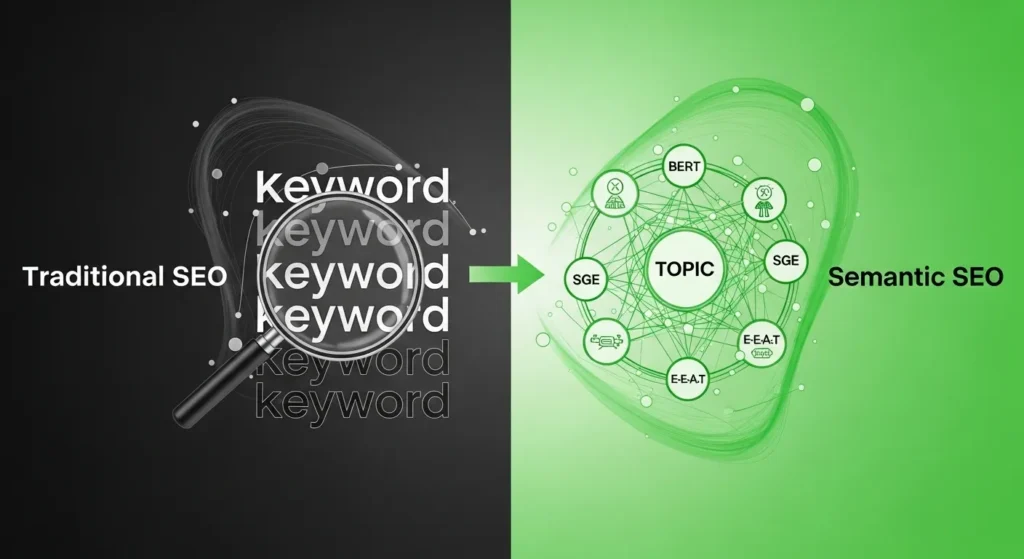
Traditional SEO focuses on keywords as the primary unit of optimization. You research which terms have search volume, assess competition, and create content targeting those specific strings. Semantic SEO focuses on topics and entities. You research which concepts define your space, identify the entities that matter, and create content that covers the topic comprehensively. Keywords still matter, but they are outputs of topic research rather than inputs.
2. Optimization target: Entities vs Strings
The optimization target differs dramatically. Traditional SEO optimizes for strings—specific sequences of characters. Semantic SEO optimizes for entities and their attributes. When you optimize for the entity “content marketing,” you naturally cover related concepts like “editorial strategy,” “audience personas,” and “distribution channels.” When you optimize for the string “content marketing,” you might just repeat that phrase until your content reads like spam.
3. Content structure: Comprehensive coverage vs Individual pages
Content structure changes under semantic SEO. Traditional approaches create individual pages targeting individual keywords, often resulting in thin content that barely covers the surface of a topic. Semantic approaches build topic clusters—comprehensive pillar pages supported by related cluster content that explores subtopics in depth. This structure signals topical authority to search engines.
4. Search understanding: Intent vs Exact match
Search understanding represents perhaps the biggest shift. Traditional SEO assumes search engines need exact-match keywords to connect queries to content. Semantic SEO recognizes that modern engines understand intent, context, and relationships. They can match your content to queries that do not contain your target keywords at all, provided you have established semantic relevance.
5. Technology: NLP/AI vs Keyword density
The technology underlying these approaches differs too. Traditional SEO relies on relatively simple information retrieval—matching documents to queries based on term frequency and link graphs. Semantic SEO relies on natural language processing, machine learning, and vector space analysis. The algorithms are not just counting words; they are mapping meaning.
6. Results: Rich snippets vs Blue links
Results manifest differently. Traditional SEO often produces rankings for specific keywords with standard blue-link results. Semantic SEO produces rich results—featured snippets, knowledge panels, people also ask entries, and passage rankings. Your content gets pulled into answer boxes and voice search responses, not just listed on page one.
7. Future-proofing: AI-ready vs Algorithm-vulnerable
Finally, future-proofing separates the two approaches. Traditional SEO chases algorithm updates, constantly reacting to changes. Semantic SEO anticipates them. As search engines get better at understanding language, entity-optimized content becomes more valuable. As AI transforms search with features like Google’s AI Overviews, semantic depth becomes the price of admission.
| Semantic SEO Approach | Traditional SEO (Legacy Approach) |
| Focus: Topics, Intent, and Entities | Focus: Exact-match Keywords and Density |
| Optimized to Meet: User intent (a complete solution) | Optimized to Meet: Search engine keyword targets |
| Content Strategy: Topic Clusters and Pillar Pages | Content Strategy: One page per keyword |
| Ranking Goal: Topical Authority and AI Visibility (GEO) | Ranking Goal: High rank for a single term |
| UX Focus: High dwell time, low bounce rate, all answers in one place. | UX Focus: Secondary to keyword placement. |
Semantic SEO bridges the gap between your content and the user’s ultimate intent, ensuring you’re seen as the most authoritative, trustworthy source.
Core Components of Semantic SEO
Implementing semantic SEO requires mastering five interconnected components. Each builds on the others, creating a system where the whole exceeds the sum of its parts.
Entity Optimization
Entity optimization forms the foundation. Entities are distinct, well-defined concepts like people, places, organizations, products, or ideas. Google maintains a vast database of entities and their relationships. Explore the full entity optimization techniques and workflow to build recognized identity.
When you mention “Neil Patel” in your content, Google does not just see a string of characters. It connects to the entity: a digital marketing expert, author, and co-founder of NP Digital, born in 1985, with specific attributes and relationships to other entities. Your content should explicitly mention relevant entities and describe their attributes. This helps search engines categorize your content and connect it to related queries.
Search Intent Alignment
Search intent alignment ensures you answer the right question. Every query carries intent—informational (seeking knowledge), navigational (seeking a specific site), transactional (seeking to purchase), or commercial investigation (researching before buying).
Semantic SEO requires you to identify the dominant intent for your target topics and structure content accordingly. Informational queries need comprehensive explanations. Transactional queries need clear value propositions and conversion paths. Misaligned intent is the silent killer of SEO performance.
Topical Depth and Coverage
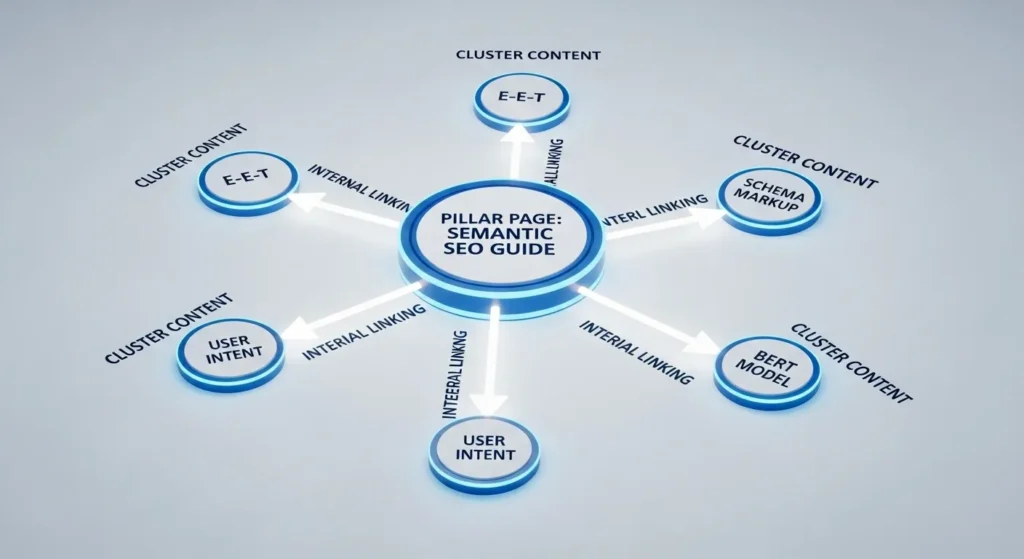
Topical depth and coverage demonstrate authority. Search engines assess whether you have covered a topic comprehensively or just touched the surface. This does not mean writing longer content for the sake of length. It means addressing the subtopics, related concepts, and questions that naturally arise when someone explores a subject. Topic clusters help here—creating a pillar page that broadly covers a core topic, supported by cluster content that explores specific aspects in detail. Internal linking between these pieces creates a semantic web that search engines can follow.
Structured Data Implementation
Structured data implementation makes your content machine-readable. Schema markup using vocabulary from Schema.org tells search engines exactly what your content means.
Article schema identifies your content type. FAQ schema marks questions and answers for rich results. Organization schema establishes your business entity. HowTo schema enables step-by-step instructions to appear directly in search results. JSON-LD is the preferred format—JavaScript Object Notation for Linked Data that embeds in your page header without disrupting user experience.
Semantic Keyword Integration
Semantic keyword integration bridges old and new approaches. While semantic SEO moves beyond keywords, terms still matter. The difference is in how you select and use them. Instead of targeting single keywords, you identify semantic keyword groups—core terms plus related concepts, synonyms, and contextual phrases. Tools like Google’s Natural Language API can analyze your content to see which entities and sentiment scores Google detects. This reveals gaps where you need more comprehensive coverage.
Five-Step Semantic SEO Implementation Framework
Theory without execution is worthless. Here is the exact framework I use with clients to implement semantic SEO.
1. Entitiy Audit: Identify core entities in your niche
Start with an entity audit. Identify the core entities in your business space. If you offer SEO copywriting services, your entities include “SEO copywriting,” “search engine optimization,” “conversion rate optimization,” “content strategy,” and specific tools or methodologies you employ. Map the attributes of each entity and the relationships between them. Wikipedia and Wikidata are excellent references for understanding how knowledge bases structure entities. Your goal is to ensure your content mentions these entities naturally and accurately.
2. Intent Mapping: Align content to search intent types
Next, map search intent to your content. For each topic you want to rank for, analyze the current search results. What content formats appear? Are there featured snippets, videos, or shopping results? What questions appear in “People Also Ask” boxes? This analysis reveals what Google believes searchers want. Your content must satisfy that intent better than existing results. If the top results are comprehensive guides, a brief overview will not compete. If they are product comparison pages, an informational blog post misses the mark.
3. Topic Clustering: Build pillar pages with cluster content
Then build your topic clusters. Select pillar topics that represent your core expertise. For my business, these include semantic SEO, SEO copywriting, and topical authority. Each pillar gets a comprehensive page—typically three thousand to five thousand words—covering the topic broadly. Then identify cluster topics—specific aspects, questions, or applications related to the pillar. Each cluster piece links to the pillar, and the pillar links back to relevant cluster content. This structure signals that you have explored the topic thoroughly.
4. Schema Markup
Implement structured data markup. Start with the basics: Organization schema on your homepage, Article schema on blog posts, and FAQ schema on pages with question-answer formats. Use Google’s Rich Results Test to validate your markup. As you expand, add more specific schemas—Service schema for your offerings, Review schema for testimonials, HowTo schema for instructional content. This markup does not directly improve rankings, but it makes your content eligible for rich results that dramatically increase visibility.
5. Internal Linking: Create contextual bridges between related topics
Finally, construct contextual internal links. Every piece of content should connect to related topics using descriptive anchor text that includes relevant entities. Do not just link to “this article” or “click here.” Link to “our guide on entity optimization” or “semantic SEO implementation strategies.” The surrounding text matters too—include contextual phrases that reinforce what the linked page covers. This builds a semantic web across your site that helps search engines understand your topical authority.
building topical authority requires strategic content clustering
Semantic SEO Examples: 3 Real-World Applications
Abstract concepts become clear through concrete examples. Here are three implementations showing before and after scenarios.
Example 1: E-commerce Product Page
An e-commerce client selling outdoor gear had product pages targeting “best hiking boots” and similar phrases. The content was technically optimized—keywords in titles, headers, and meta descriptions—but rankings stalled.
We implemented semantic SEO by expanding entity coverage. Instead of just mentioning “hiking boots,” we covered specific entities: Gore-Tex waterproofing technology, Vibram sole construction, ankle support features, and break-in periods. We added schema markup for Product, Review, and FAQ.
Six months later, the pages ranked for hundreds of long-tail queries they had never targeted specifically, and organic revenue increased forty-three percent.
Example 2: B2B SAAS Page
A B2B software company wanted to rank for “project management software.” Their original approach created a features page listing capabilities in bullet points.
We transformed this into a comprehensive guide covering the entity “project management methodology” and its relationships to agile, waterfall, and hybrid approaches. We included entities like “resource allocation,” “critical path analysis,” and “stakeholder communication.”
The page became a topical hub linking to cluster content about implementation, team training, and integration with other tools. It now ranks in the top three for the primary term and captures featured snippets for dozens of related questions.
Example 3: B2B Service Page
My own site demonstrates semantic SEO for professional services. Rather than creating separate pages for every keyword variation of “SEO copywriter,”
I built topical authority around semantic SEO copywriting as a central entity. Content covers related concepts like search intent analysis, conversion psychology, and content engineering. This approach generated a three hundred seventeen percent increase in qualified leads within ninety days—not from keyword stuffing, but from comprehensive topical coverage that search engines recognize as authoritative.
Why Semantic SEO Matters for AI Search
The search landscape is transforming again. Generative AI, large language models, and AI Overviews are changing how people find information. Semantic SEO positions you to thrive in this new environment.
Large language models like GPT-4 and Google’s Gemini generate answers by synthesizing information from multiple sources. They cite content that demonstrates clear entity relationships, factual accuracy, and comprehensive coverage. Thin, keyword-stuffed content gets ignored. Deep, semantically structured content gets referenced.
Google’s AI Overviews pull information directly into search results, reducing click-through rates for basic queries. But they also create new opportunities. When your content is the source for an AI Overview citation, you gain visibility without the click—and users seeking deeper information still visit your site. Semantic optimization makes your content more likely to be selected as a source.
Vector search is becoming standard. Instead of matching keywords, AI systems retrieve content based on semantic similarity to queries. If your content exists in the same vector space as user questions—meaning you cover the topics and entities they care about—you appear in results even without exact keyword matches.
The sites that invested in semantic SEO before AI search arrived are now the default sources for generative answers. Those that clung to keyword tactics are scrambling to rebuild. The window for establishing authority is closing as AI systems solidify their training data preferences.
Common Semantic SEO Mistakes to Avoid
Even well-intentioned efforts fail when they misunderstand semantic principles. Watch for these errors.
- Confusing LSI keywords with semantic keywords is widespread. Latent Semantic Indexing was a patented technique from the 1980s that Google has never used for search rankings. SEO tools marketed “LSI keyword” suggestions for years, but these are essentially just related terms. True semantic optimization goes beyond related words to entity relationships and conceptual coverage.
- Over-optimizing for entities creates new spam. Mentioning every entity related to your topic repeatedly does not help. It hurts. Semantic SEO requires natural language that humans find valuable. If your content reads like an entity list rather than useful information, search engines recognize the manipulation.
- Ignoring search intent mismatch destroys performance. You can have perfect entity coverage and still fail if you answer the wrong question. A page optimized for “semantic SEO” that only discusses history will not rank for “how to implement semantic SEO.” Intent analysis must precede content creation.
- Neglecting structured data leaves money on the table. Without schema markup, search engines must guess what your content means. With it, you explicitly define entities, attributes, and relationships. The implementation cost is minimal compared to the visibility gains.
- Creating thin content within topic clusters undermines the entire strategy. A pillar page supported by five hundred-word cluster pieces signals that you have not actually explored the topic. Each cluster piece should stand alone as valuable content while contributing to the broader topical authority.
Top Semantic SEO Tools
No single tool is enough, but combining a few allows you to effectively implement the strategies above.
| Tool | Focus & How to Use It |
| Google Search Console | FREE. Essential for finding the long-tail queries (semantic keywords) your page already ranks for, and which subtopics to expand. It also monitors your Core Web Vitals. |
| Answer The Public | FREE/Paid. Excellent for quickly generating question-based and prepositional queries (“Semantic SEO for a startup,” “Semantic SEO vs keyword stuffing”) to use as subheadings and PAA answers. |
| Google Autocomplete & Related Searches | FREE. Your fastest source for discovering immediate LSI/semantic keywords and user intent signals. Use these suggestions as subtopic ideas. |
| Surfer SEO / Clearscope / Frase (Paid) | Paid (Recommended). These content optimization tools use AI/NLP to compare your content against the top-ranking pages, score your topical coverage, and suggest relevant entities/semantic keywords to include. |
| LLMrefs (Emerging GEO Tool) | Paid (Specialized). A new class of tool that specifically tracks if and how often your content is cited by Large Language Models (LLMs) like ChatGPT or Perplexity, helping you measure your Generative Engine Optimization (GEO) success. |
Frequently Asked Questions
Is semantic SEO different from technical SEO?
Yes, though they overlap. Technical SEO focuses on site infrastructure—crawlability, speed, mobile-friendliness, and indexation. Semantic SEO focuses on content meaning and entity relationships. You need both. Technical SEO ensures search engines can access your content. Semantic SEO ensures they understand it.
How long does semantic SEO take to show results?
Typically three to six months for established sites, six to twelve months for new sites. Semantic SEO builds cumulative authority. Early results often appear as rankings for long-tail queries you did not explicitly target. As topical authority strengthens, primary keyword rankings follow.
Can I use AI tools for semantic SEO?
Yes, with caution. AI writing tools can help generate content drafts, but they require human editing for entity accuracy and depth. AI research tools can identify related topics and entities. However, AI-generated content often lacks the unique insights and original data that distinguish authoritative content. Use AI for efficiency, not replacement of expertise.
What is the difference between entities and keywords?
Keywords are strings of characters. Entities are real-world concepts with attributes and relationships. “Apple” is a keyword that could refer to multiple things. Apple Inc. is an entity with specific properties like founder, headquarters, and products. Semantic SEO optimizes for entities. Traditional SEO optimizes for keywords.
Do I need to abandon keyword research?
No. Keyword research remains valuable for understanding search demand and language patterns. But it is an input to topic research, not the final output. Use keywords to identify what people search for, then build comprehensive entity-based content that satisfies the underlying intent.
Semantic SEO is not a tactic. It is a strategic shift in how you approach organic search. The businesses that master it now will dominate their categories for years. Those that delay will find the barrier to entry rising as AI systems solidify their understanding of which sources to trust.
If you are ready to implement semantic SEO for your business, I offer professional semantic SEO services that include entity audits, topical map development, and content engineering. The framework outlined here is just the beginning—execution requires precision, consistency, and technical expertise.
Start with your entity audit this week. Identify the core concepts that define your expertise. Build one comprehensive pillar page. Create the semantic web that search engines cannot ignore. The algorithms will not wait for you to catch up.