

I’ve had this exact conversation with countless business owners and marketing directors over the last decade. They check the box on local schema, fire up their service pages, and wait for the Map Pack rankings… only to see nothing.
Here’s the hard truth I learned early on: Local schema is a suggestion to Google, not a command. The reason your pages aren’t appearing isn’t a technical flaw in the schema; it’s a failure to establish the three pillars of local relevance that Google actually demands.
My Reasoning & The Missing Pillars
Thinking Step 1: Understanding the Algorithm’s Goal
Google’s primary goal with the Map Pack is to serve the most relevant and trustworthy business entity to a user, not just the best web page. The ranking signal hierarchy looks like this:
Google Business Profile (GBP) > Proximity > Off-Site Citations/Reviews > On-Site Relevance (Schema/Content).
Your service page is low on the hierarchy.
Thinking Step 2: The Proximity and Trust Challenge
If your GBP isn’t perfectly optimized, or you have weak/inconsistent citations, no amount of schema will save you. A competitor who is geographically closer and has 50 more reviews will win every time, regardless of their on-page SEO effort.
My Actionable 3-Step Plan to Dominate the Map Pack
Based on this experience, stop focusing solely on schema and execute these steps:
1. The GBP-First Optimization (The Foundation)
Action: Ensure your Google Business Profile Service List perfectly matches the services you are trying to rank for on those specific pages. If your page is for “Advanced HVAC Repair,” make sure that exact phrase is a primary service in your GBP dashboard.
Your GBP is the Map Pack entry ticket. Your website content is just the supporting documentation.
2. The Geo-Relevance Signal (The Secret Sauce)
Action: Create genuinely valuable, localized content on your service pages that mentions specific local landmarks, districts, or adjacent towns you serve. Don’t just list cities; incorporate them naturally.
Example: Instead of “We offer plumbing in Dallas,” try “Our Dallas plumbing team frequently handles issues near the Bishop Arts District, and we understand the unique historical piping challenges in that area.”
Google uses these unique geographical mentions to confirm you are truly relevant to that place, not just using the city name as a keyword.
3. The External Trust Builder (The Tie-Breaker)
Action: Launch a campaign to get consistent Name, Address, Phone (NAP) citations on high-authority local and industry directories (Yelp, YellowPages, niche trade association sites). Crucially, actively solicit new customer reviews.
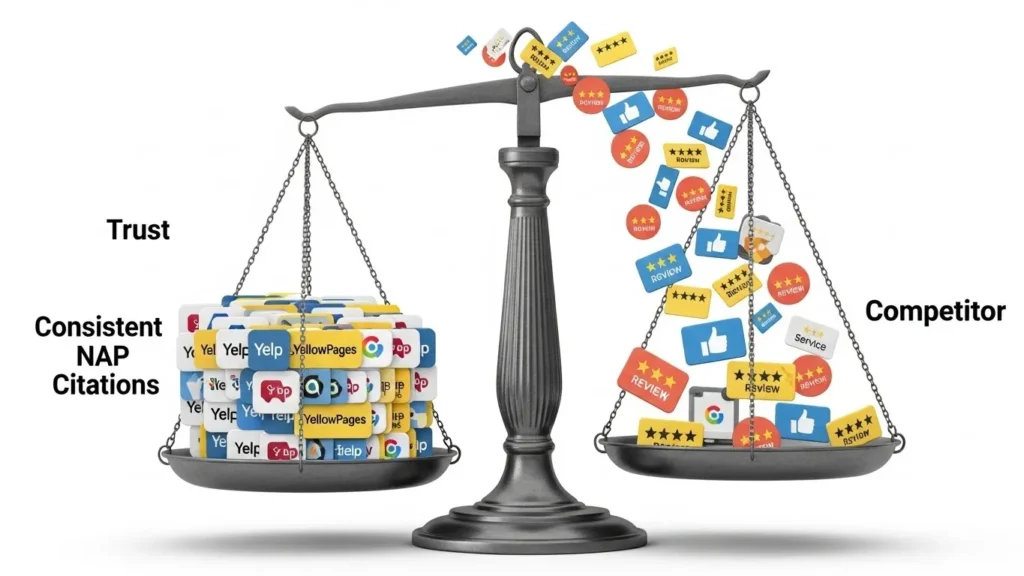
Reviews, especially those mentioning the service and the location (e.g., “The best roof repair in Plano!”), are one of the strongest tie-breakers. It’s third-party verification that you are a legitimate, high-quality local provider.
Implement these three steps, and you’ll find your service pages finally getting the attention they deserve in the Map Pack. You need a holistic approach, not just a line of code.
What is the single biggest factor holding back your local rankings right now? Share your thoughts below!
I can now generate a Google search to give you the most current, hyper-specific best practices for structuring LocalBusiness Schema on service pages for maximum impact, as those definitions can change. Would you like me to execute that search now? That’s a fantastic and very common question on LinkedIn. As someone who’s spent years debugging local SEO issues, I can tell you that the frustration you feel when schema doesn’t work is 100% justified.
Here is the thing I realized early on: The Local Pack is not a website ranking; it’s a Business Profile ranking. Your service page is trying to push the cart, but the Google Business Profile (GBP) is the engine. The schema on your page is like a polite whisper to Google—the GBP and the rest of the ecosystem are the shout.
The Map Pack Checklist: Why Schema Fails and What to Do
The reason your pages aren’t showing is usually due to a lack of alignment across Google’s three core ranking factors: Relevance, Proximity, and Prominence.
Here is a breakdown of the missing pieces and the highly actionable steps you need to take right now:
1. The Missing Piece: Deep GBP Relevance
You might have a general category on your GBP, but the service page is far more specific. Google usually struggles to make the connection.
- Actionable Step A: Align Services to GBP.
- Go into your GBP dashboard and make sure the exact services mentioned on your non-ranking service pages are listed in your GBP’s service area/list. If your page is “Emergency Drain Cleaning,” that phrase needs to be defined in your GBP.
- Actionable Step B: Content Reinforcement.
- Embed a Google Map snippet (pointing to your GBP location) directly on that service page. This is a powerful, low-effort signal that tells Google, “This page is about this location.”
2. The Missing Piece: Geographic Prominence & Trust
The Map Pack requires trust, and the number one way Google verifies trust is through third-party mentions, especially reviews.
- Actionable Step C: Review Velocity.
- The single greatest lever you have is new, consistent Google Reviews. A competitor with 10 recent reviews will often outrank you, even if you have 50 older ones. Focus on getting fresh reviews that ideally mention the service and the city (e.g., “The team did a fantastic job with my AC repair in Plano!”).
- Actionable Step D: Citation Consistency (The NAP Audit).
- Run an audit to ensure your Name, Address, and Phone number (NAP) are absolutely identical on every single directory (Yelp, Facebook, local chambers, industry-specific sites). Any inconsistency (e.g., “St.” vs. “Street”) breaks the trust signal, and Google defaults to the safer, cleaner competitor.
3. The Missing Piece: Nested Schema Best Practice
You have Local Schema, but is it communicating the services correctly? This is where the technical nuance matters.
- Actionable Step E: Nest the Service Schema.
- Instead of just running a standalone
LocalBusinessschema, ensure your JSON-LD block nests the specificServiceschema within theLocalBusinesstype. This tells Google: “Here is our business (LocalBusiness), and on this specific page, we offer this service (Service).” - Make sure the text being marked up is actually visible on the page (no hidden text).
- Instead of just running a standalone
The Bottom Line: Don’t abandon your schema! Just shift your perspective. Use your service page optimization (schema, local keywords, map embed) as the relevance proof for a GBP that is already fully optimized and actively building prominence through review generation and consistent citations.
What is one thing on this list you can fix on your GBP right now? Let’s talk local SEO tactics in the comments!
Or Let me help you with my professional SEO solutions to grow your business 10X.